Oliver Oglethorpe Ogled an Owl and Oyster
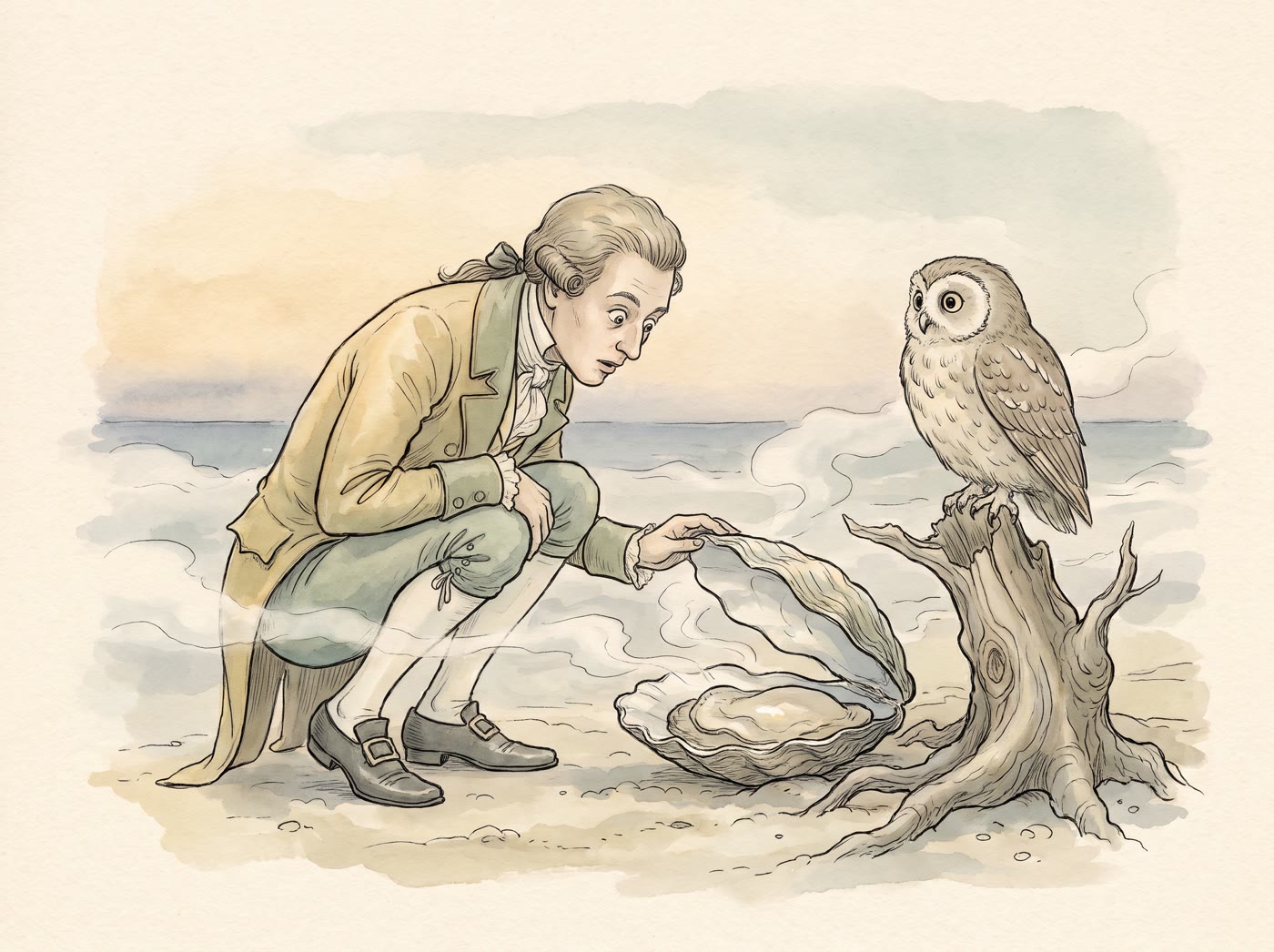
Oliver Oglethorpe ogled an Owl and Oyster:
Did Oliver Oglethorpe ogle an Owl and Oyster?
If Oliver Oglethorpe ogled an Owl and Oyster,
Where are the Owl and Oyster Oliver Oglethorpe ogled?
Where the rhyme comes from
Oliver Oglethorpe is the O of an alphabet of tongue twisters, Peter Piper’s Practical Principles of Plain and Perfect Pronunciation, published by John Harris at St Paul’s Churchyard in London. The book is usually dated 1813, but the book itself carries no date, so that figure is a bibliographers’ dating rather than something printed on the title page. Harris was the publisher; nothing we have found shows that he wrote it, and Project Gutenberg, which holds the 1836 edition, lists the book as anonymous.
The plan is simple: one alliterative character for each letter, A to W, followed by a joint entry for X, Y and Z. The most famous entry is Peter Piper and his peck of pickled peppers. The words above are the ones printed in the 1836 Philadelphia edition (Willard Johnson), which we have read in full. We have not read the London original, and the wording of other verses in the book is known to differ between printings, so we cannot promise that this one is unchanged since 1813. We have kept the old capitals on Owl and Oyster; modern versions often print them in lower case, which changes nothing but the typography.
The book’s own preface sets the tone, promising to “Produce these Puzzling Pages, Purposely to Please the Palates of Pretty Prattling Playfellows.” The structure of the O entry is typical of the whole alphabet, and you can see the same shape in Gaffer Gilpin and Neddy Noodle: a statement, then a doubting question, then an “if” restatement, then a closing question that begins with “where”. Duncan Emrich, a folklorist at the Library of Congress, wrote in 1955 that Peter Piper alone circulates widely by word of mouth, while “all of his other delightful companions” — Oliver, by implication, among them — live “a half life on the printed page”. That was his observation in 1955, not a measurement of today.
What does it mean?
Nothing, in the sense of a story. We know of no real Oliver Oglethorpe behind the name, and no source tells us what the verse-maker had in mind; the name is there because it is full of round O sounds. The owl and the oyster look like a similar choice — two creatures that begin with a vowel and sound nothing alike.
The word “ogled”. To ogle is to stare at someone or something, and in modern English it usually carries a note of impertinence or amorous looking. The word entered English in the late seventeenth century and is probably from Low German, though dictionaries are not unanimous about its route. For a reception class there is no need to dwell on the leer: “stared at” or “looked at with big round eyes” does the job, and the verse itself is perfectly clean.
A teaching tool. Alphabets like this were part of a wider habit of pronunciation drills; Emrich notes older elocution books that offered such exercises as “recreations in articulation”. Whether this particular verse was used that way, we cannot say.
Sharing it with children
This is an unusual twister, because the sound it repeats is a vowel rather than a consonant, so the tongue is not tripping over the same consonant again and again. The challenge is that the line holds several different O sounds: the short o of Oliver, the long o of Oglethorpe and ogled, the ow of owl and the oy of oyster. Say each one on its own first, with lips rounded, then put them back into the line.
Start with the owl. Children can hoot a long “oo-oo” while making big round eyes with finger-and-thumb circles, then switch to an “oy” for the oyster, clapping their hands together like a shell. Move on to one line at a time, slowly, and speed up only when it sounds clean.
Because the verse is a question and answer, it works as a game for two. One person asks, “Did Oliver Oglethorpe ogle an Owl and Oyster?” and the other must reply “Yes, Oliver Oglethorpe ogled an Owl and Oyster” without stumbling. The last line — where are they? — invites a made-up answer, so let the child decide where the owl and the oyster have gone. You could also go on an O hunt around the room, collecting objects and words that begin with the same sound. How Many Yaks is another twister built as a question, and makes a good partner game once this one is clean.
Extra verses to sing
These verses aren’t traditional — they’re ours. They copy the four-line pattern of the original: a statement, a doubting question, an “if”, and a question to finish.
Olive Ottoway offered an Otter an Orange:
Did Olive Ottoway offer an Otter an Orange?
If Olive Ottoway offered an Otter an Orange,
Where is the Orange Olive Ottoway offered?
Ollie Orchard opened an Oven on Oatcakes:
Did Ollie Orchard open an Oven on Oatcakes?
If Ollie Orchard opened an Oven on Oatcakes,
Where are the Oatcakes Ollie Orchard opened?