Georgie Porgie
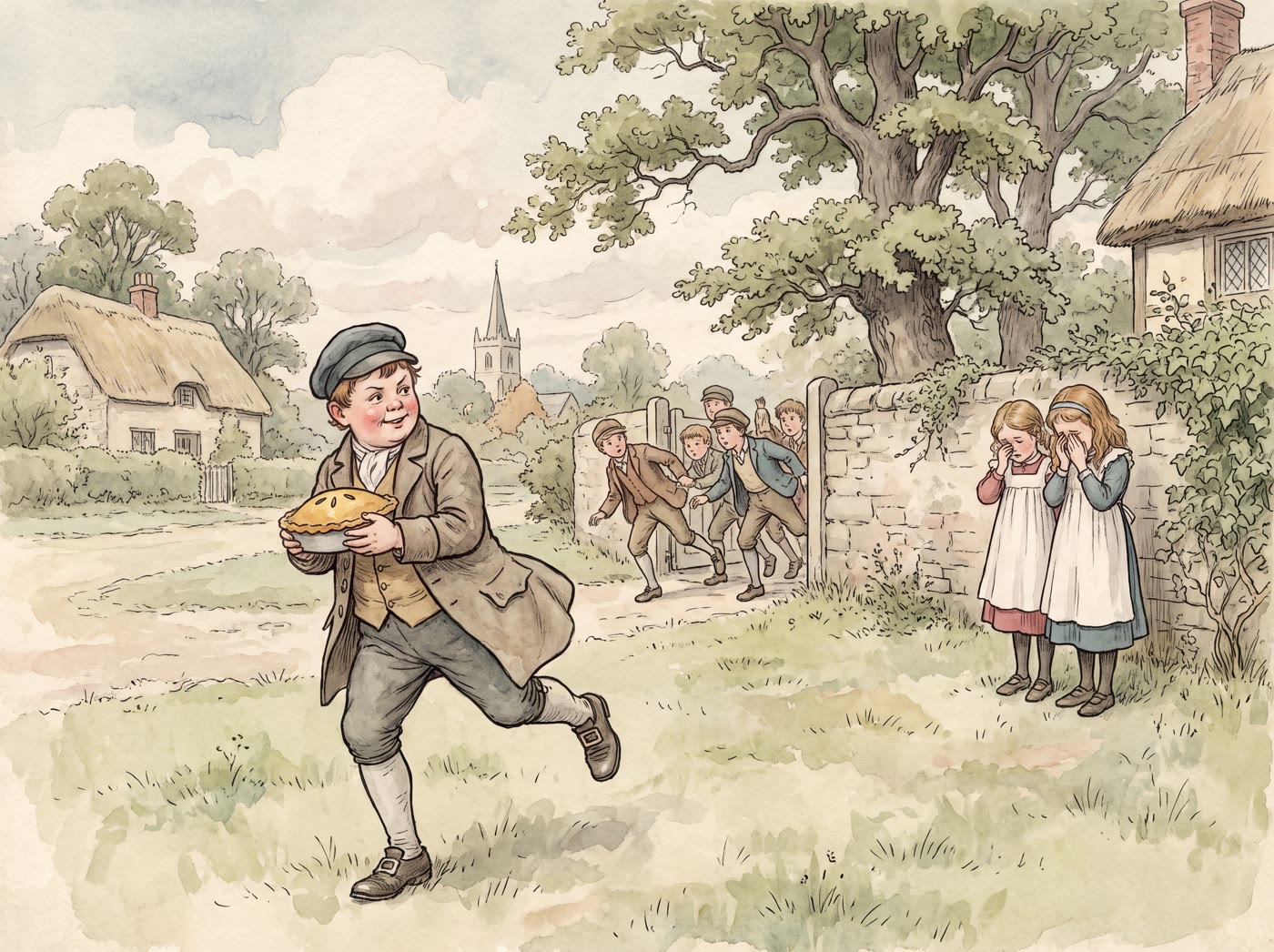
Georgie Porgie,
Pudding and pie,
Kissed the girls and made them cry.
When the boys came out to play,
Georgie Porgie ran away.
Where the rhyme comes from
Georgie Porgie first appeared in print in The Kentish Coronal in 1841, a collection of prose and poetry by writers connected with the county of Kent. There the rhyme was printed as a fragment of what the editor called an “old ballad”, and the name was spelled “Georgy Peorgy”. The last two lines ran rather differently: “When the girls came out to play, Georgy Peorgy ran away.”
A close cousin turns up the very next year in James Orchard Halliwell’s The Nursery Rhymes of England (1842), where the hero is called “Rowley Powley” — another old nickname for a plump person, much like “roly-poly”. The rhyme was set to music by James William Elliott for National Nursery Rhymes (London, 1870), illustrated by the Dalziel brothers. The familiar third line, “When the boys came out to play”, appears by 1884, and it was this version that Iona and Peter Opie chose for The Oxford Dictionary of Nursery Rhymes (1951) — which is why it is the one nearly everybody sings today.
What does it mean?
On the surface it is a playground taunt: a boastful boy who torments the girls but bolts the moment other boys appear. Children have flung it at any classmate named George for well over a century, and it was sometimes flipped to “Rosie Posie” to tease the girls instead. Several grander explanations are often repeated, but the evidence for all of them is thin:
George Villiers, Duke of Buckingham. A popular story identifies Georgie Porgie with the 1st Duke of Buckingham (1592–1628), a royal favourite famous for his amours and accused of shrinking from a fight. It is a tidy fit — but Buckingham died more than two centuries before the rhyme reached print, and no contemporary source connects him to it. Treat it as folklore.
George IV. Others point to George IV, mocked in his own day for his bulk (hence, supposedly, “pudding and pie”), his many mistresses and his distaste for anything violent. This theory is more plausible on dates, since he died only eleven years before the 1841 printing — but again it is conjecture, with no evidence linking king to rhyme.
Charles II, and others. The Opies noted that “popular tradition insists” on Charles II, and King George I has been proposed too. Folklorists generally regard all of these as unsubstantiated guesses attached to the rhyme long after the fact. The likeliest truth is the plainest one: Georgie Porgie is nobody in particular, and that is exactly why children could aim him at anybody.
Sharing it with children
This is a lovely lap rhyme with a built-in joke. Bounce a child gently on your knee through “Georgie Porgie, pudding and pie”, give a big soft smacking kiss on the cheek at “kissed the girls”, then let your knees go bouncing fast for the run-away line and finish with a swoop and a giggle. Older children enjoy it as a chase game: one Georgie, a blowing of kisses, and everybody scattering on “ran away”.
It is also a gentle opening for a conversation. Ask why the girls cried, and whether Georgie should have asked first — a rhyme about a boy who kisses people who do not want to be kissed makes a surprisingly natural way to talk about asking before you hug. And “pudding and pie” is a fine excuse to bake something together afterwards.
Extra verses to sing
These verses aren’t traditional — they’re ours. Sing them if you would like Georgie to mend his manners.
Georgie Porgie,
Custard and cream,
Hid in the hedgerow beside the stream.
The boys ran past and never knew,
But the blackbird saw, and the blackbird flew.
Georgie Porgie,
Home again, said:
“I’ll ask them first,” and he hung his head.
Now when the boys come out to play,
Georgie Porgie says, “May I stay?”