Here We Go Looby Loo
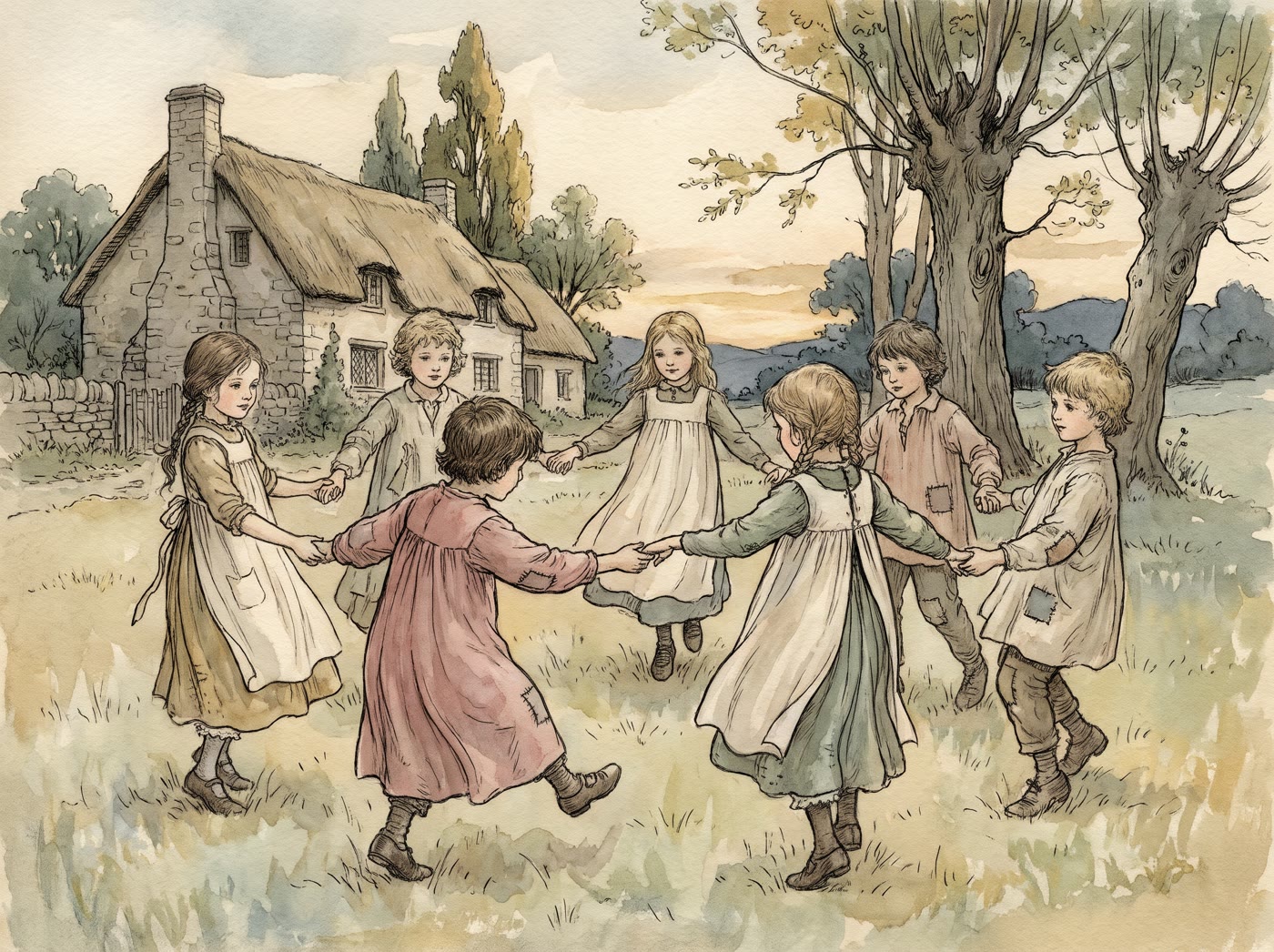
Here we go looby loo,
Here we go looby light,
Here we go looby loo,
All on a Saturday night.
You put your right hand in,
You take your right hand out,
You give your hand a shake, shake, shake,
And turn yourself about.
(Repeat the refrain, then the same verse for the left hand, the right foot, the left foot, the head and the whole self.)
Where the rhyme comes from
Nobody can name an author or a date for the words above. This is the version commonly sung today, and wordings vary from family to family and nursery to nursery; we are not claiming that this exact text appears in any single early book. What can be shown is that a close ancestor was being danced in the nineteenth century.
The earliest printed form we have read is in James Orchard Halliwell’s Popular Rhymes and Nursery Tales (1849), in a chapter of game-rhymes, under the title “Dancing Looby”: “Now we dance looby, looby, looby, / Now we dance looby, looby, light. / Shake your right hand a little / And turn you round about.”
Halliwell goes on with the left hand, the right foot, the left foot and the head, each verse opening with the same “Now we dance looby” line. His instruction for the game is brief and clear: “Children dance round first, then stop and shake the hand, &c., then turn slowly round, and then dance in a ring again.” He gives no source and no date, and says nothing about what “looby” means. The same chapter prints the bramble-bush and mulberry-bush ring games, so by 1849 the looby dance already had “here we go” neighbours in print.
Later printings, as reported by secondary sources rather than seen by us in the originals, bring the words closer to the modern ones. A version of the rhyme in Walter Crane’s The Baby’s Bouquet (1878) is said to end its refrain “as yesternight”, and a Sheffield version in G. F. Northall’s English Folk-Rhymes (1892) is reported to have a “Here we go, Looby Loo” refrain and a Saturday night. The song has other names, too: Looby Light, Here We Dance Looby Loo, Loopty Loo and Loop de Loop among them.
What does it mean?
The name. Nobody knows what “looby loo” means. Halliwell offers no explanation, and we have found no scholarly one. It looks like the kind of rhythmic nonsense that circle songs often collect, and it is safest to treat it that way.
The Saturday-night bath. A popular explanation says the song is about bathing on a Saturday night. We have found no evidence for it: Halliwell’s version names no night at all, and the oldest texts we have seen say nothing about baths. Enjoy it as folklore, not history.
The cousin with the same moves. The in, out, shake and turn of the modern song will be familiar to anyone who knows the Hokey Cokey, and the resemblance is real: nineteenth-century versions of the two overlap, and the songs have been described as sharing a common origin. The Hokey Cokey itself is a later music-hall and dance-hall hit, popular in Britain in the 1940s, and we do not reproduce its words here.
Sharing it with children
This is a ring game first and a song second. Halliwell’s sequence, with today’s in-and-out added, works well: hold hands and walk or skip round during the refrain, stop, then put the named hand or foot into the circle, shake it, turn slowly round on the spot and take hands again. Add one body part per verse — left hand, right foot, left foot, head — and finish with the whole self.
With the youngest, sit in a circle and use hands only. With older children, let a different child call the next body part, speed up with each verse, or swap “looby loo” for a silly word of the group’s choosing; these are modern ways to play rather than anything traditional. It is also a gentle way to practise left and right. Leave plenty of room, and keep an eye on heads when the whole circle leans in.
Extra verses to sing
These verses aren’t traditional — they’re ours. Sing them when the circle has run out of body parts.
You put your elbow in,
You take your elbow out,
You give it a wiggle, wiggle, wiggle,
And twirl yourself about.
You put your fingers in,
You take your fingers out,
You flutter them like leaves in the wind,
And spin yourself about.