The Farmer in the Dell
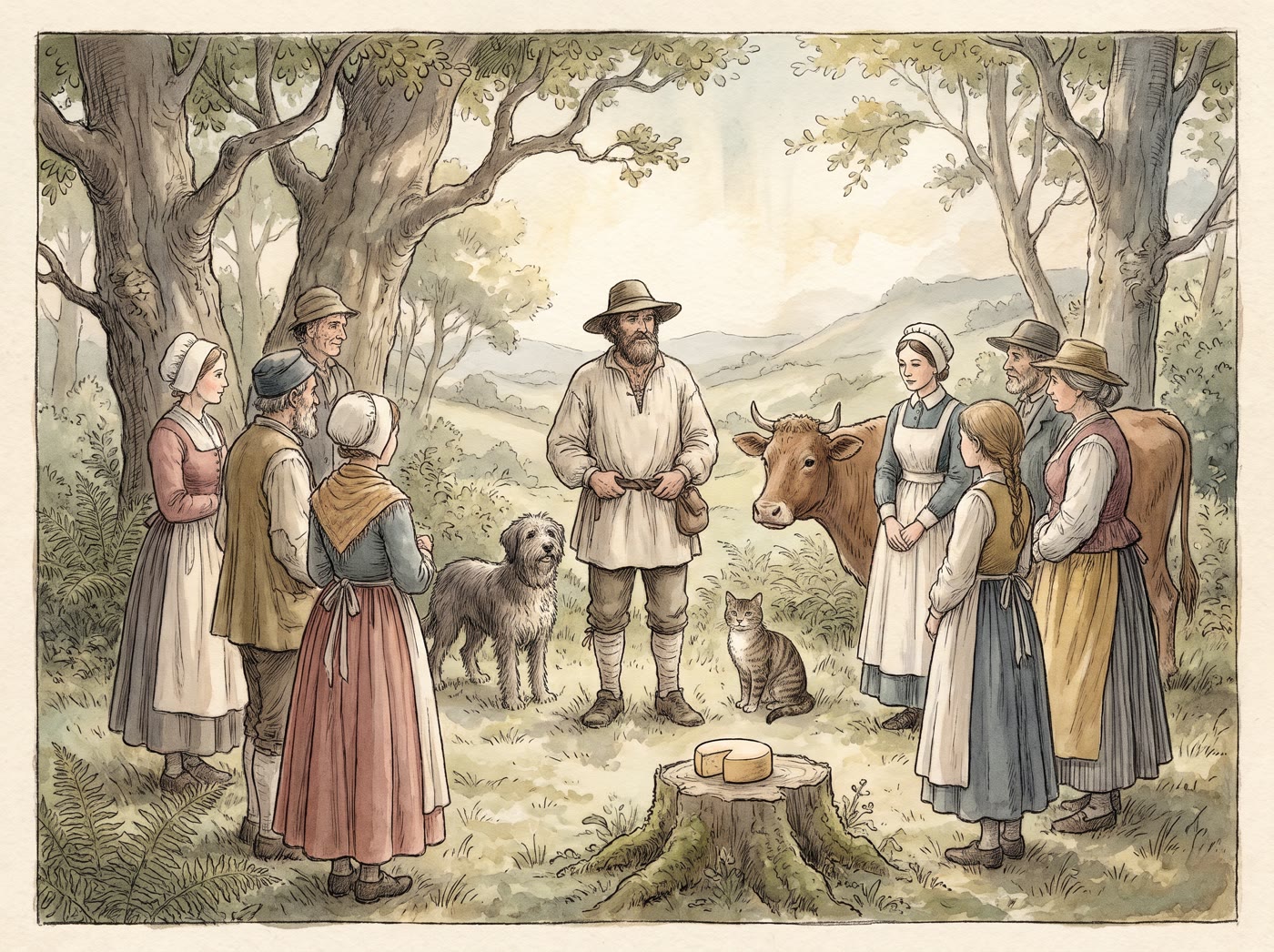
The farmer in the dell,
The farmer in the dell,
Hi-ho, the derry-o,
The farmer in the dell.
The farmer takes a wife,
The farmer takes a wife,
Hi-ho, the derry-o,
The farmer takes a wife.
The wife takes the child,
The wife takes the child,
Hi-ho, the derry-o,
The wife takes the child.
The child takes the nurse,
The child takes the nurse,
Hi-ho, the derry-o,
The child takes the nurse.
The nurse takes the cow,
The nurse takes the cow,
Hi-ho, the derry-o,
The nurse takes the cow.
The cow takes the dog,
The cow takes the dog,
Hi-ho, the derry-o,
The cow takes the dog.
The dog takes the cat,
The dog takes the cat,
Hi-ho, the derry-o,
The dog takes the cat.
The cat takes the rat,
The cat takes the rat,
Hi-ho, the derry-o,
The cat takes the rat.
The rat takes the cheese,
The rat takes the cheese,
Hi-ho, the derry-o,
The rat takes the cheese.
The cheese stands alone,
The cheese stands alone,
Hi-ho, the derry-o,
The cheese stands alone.
Where the rhyme comes from
The earliest English text that the standard indexes can point to is in William Wells Newell’s Games and Songs of American Children (Harper, 1883), where it is number 64, noted from children in New York. It is catalogued as Roud 6306. One indexer suspects it could be decades older than that, but this is a suspicion rather than evidence.
The likely ancestor is German. A singing game called Es fuhr ein Bau’r ins Holz is recorded from 1826, and Iona and Peter Opie, in The Singing Game (1985), take that to be probably where our rhyme began, probably carried to America by German immigrants. It was a different story, though: a courtship game in which a farmer chooses a wife, then a child, a maid and a serving man. There are no animals and no cheese. Newell himself, as summarised by later writers, knew a German version that was also played in New York, and wondered whether the English words might be a recent translation.
From there the game spread. The Opies, as summarised by later writers, record it in Canada in 1893, in Scotland in 1898 and in England from 1909. In Britain the first line is often “The farmer’s in his den”, and the chain can run farmer, wife, child, nurse, dog and bone, ending with everyone patting the child chosen as the bone. Other collectors recorded “The Farmer in the Dale” and “The Farmer in His Den” in Aberdeenshire. We have found no evidence for any claim that the rhyme began in Scotland; it simply turns up there in the 1890s.
Even the words printed above are not fixed. They are the ones most often sung, but some families have a mouse where we have a rat, some leave the cow out, and the refrain changes from place to place.
What does it mean?
The dell. A dell is an ordinary English word for a small wooded valley, and that is probably all the song intends: it is where the farmer lives. No source connects the word to the rhyme’s origins, and the British “den” and “dale” show how easily it shifted in the singing.
Hi-ho, the derry-o. No known meaning. It reads as nonsense filler, and the variants suggest it was interchangeable: “Hi-ho, the merry-o”, “Ee-i, tiddly-i” in London, “Ee-i, adio” in the north of England, “Ee-i, ee-i” in the West Country. It is also often misheard, which is why people search for “hi ho the dario”.
Why does the cheese stand alone? Because it is a selection game. The last player chosen is left out of the circle, and in Newell’s description, as later writers summarise it, the cheese is “clapped out” and becomes the farmer for the next round. Readings of the cheese as a lesson in loneliness or social order are modern speculation; we have found no scholarly source for them.
Sharing it with children
The game is the point. Players join hands in a circle and walk round the player in the middle, the farmer, singing the first verse. When it ends everyone stops and the farmer chooses a wife, who joins him in the centre. Each verse another player is chosen, until the cheese is left, and the cheese usually becomes the farmer next time. A circle of five or six children is plenty.
For the youngest, make the choosing gentle: let the farmer point rather than pull, or let the adult choose for them. With a single toddler, play it as a lap rhyme, bouncing knees for the walking verses and giving a small squeeze for each new “taking”. Children who know the animals can do the noises — the crowing game from Cock a Doodle Doo makes a good farmyard warm-up — and the cheese is a good excuse for a big flourish at the end.
If you want a game with more counting and chanting in the same ring-and-walk style, try Here We Go Round the Mulberry Bush.
Extra verses to sing
These verses aren’t traditional — they’re ours. Add them if you would like the cheese to have a happier ending.
The cheese takes a bow,
The cheese takes a bow,
Hi-ho, the derry-o,
The cheese takes a bow.
The cheese is the farmer,
The cheese is the farmer,
Hi-ho, the derry-o,
The cheese is the farmer.