Cock a Doodle Doo
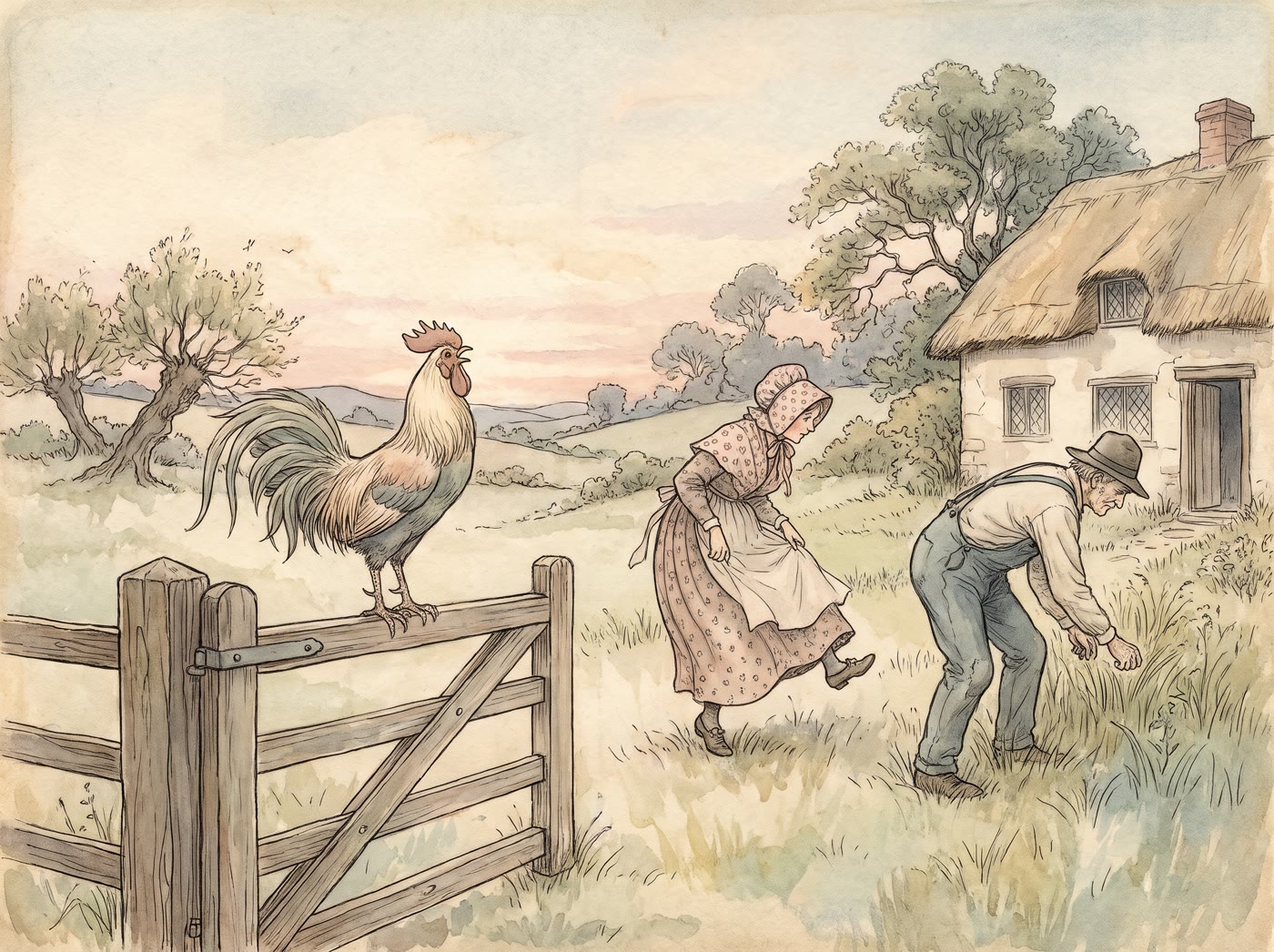
Cock a doodle doo!
My dame has lost her shoe,
My master’s lost his fiddling stick
And knows not what to do.
Cock a doodle doo!
What is my dame to do?
Till master’s found his fiddling stick,
She’ll dance without her shoe.
Cock a doodle doo!
My dame has found her shoe,
And master’s found his fiddling stick,
Sing cock a doodle do!
Cock a doodle doo!
My dame will dance with you,
While master fiddles his fiddling stick,
And knows not what to do.
Where the rhyme comes from
The Opies, in The Oxford Dictionary of Nursery Rhymes, give the first full version as one printed in London in Mother Goose’s Melody, a collection issued by the Newbery firm and usually dated to around 1765. That is a loose date: the sources give it only approximately, so “around” is as firm as it is honest to be. The opening verse above is the version most often given today.
The three further verses may be a later growth. According to the Opies, by the middle of the nineteenth century, when James Orchard Halliwell gathered the rhyme, it was very popular and had acquired these extra verses, which they suggest may be more recent in origin. Wordings differ from book to book. A children’s anthology of 1901 has “And don’t know what to do” in the first verse and ends its last with “For dame and doodle doo”, and an edition of Gammer Gurton’s Garland from around 1820 gives a version in which it is the cat who has lost the fiddle-stick. The words above follow the Opie-derived text; other versions are just as legitimate.
The crow itself is older than the rhyme. The Oxford English Dictionary records “cock-a-doodle-doo” from 1573, in the writing of the scholar Gabriel Harvey, and describes it as an imitative formation — a word made by ear rather than derived from anything. Other languages hear the same bird differently: French has cocorico, German kikeriki, Russian kukareku.
What does it mean?
The meaning, if there is one, is unknown. On the surface it is domestic nonsense: a household in a muddle, a lost shoe, a lost fiddle bow, and a rooster announcing the morning over the top of it all. In plain terms, the dame is the mistress of the house, the master is the man of the house, and the fiddling stick is presumably the bow used to play a fiddle. Some modern websites read political or historical allegories into the lines; none comes with evidence, and it is better to enjoy the rhyme as the light-hearted piece it appears to be.
Sharing it with children
Start with the crow. Make it a call-and-response game: the adult crows “cock a doodle doo!” and the child crows back, first as quietly as a rooster at the very edge of dawn, then as loudly as the farmyard will allow. Swapping the roles is half the fun.
The lines mime themselves. Hop on one foot and pat your bare toes for the lost shoe; peer under a cushion; then make a sawing motion with one arm for the fiddling stick, and shrug with open hands on “knows not what to do”. In the later verses, dance in your socks for “she’ll dance without her shoe”, and finish with a flourish when the shoe is found. A hide-and-seek version works well: hide one of the child’s shoes and chant the first verse while they hunt for it. If shoes are the interest, One, Two, Buckle My Shoe makes a natural follow-on.
Extra verses to sing
These verses aren’t traditional — they’re ours. Sing them after the traditional words if the farmyard needs a few more things to find.
Cock a doodle doo!
My dame is looking for you,
For somebody’s hat is nowhere about,
And the hens are all in a stew.
Cock a doodle doo!
On the cockerel’s head, it’s true,
So the shoe and the stick and the hat are all found,
And the morning is bright and new.