Little Boy Blue
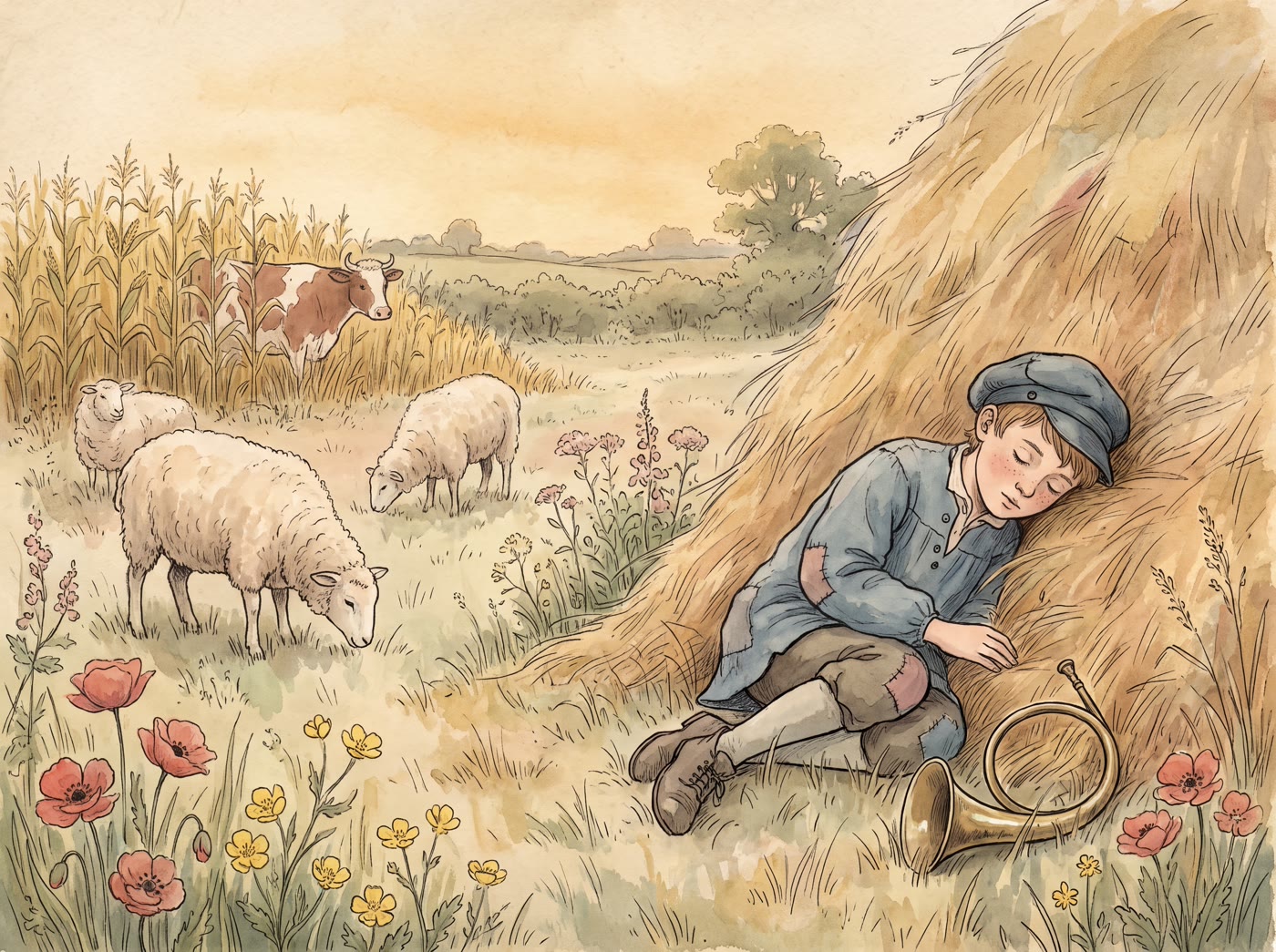
Little Boy Blue,
Come blow your horn,
The sheep’s in the meadow,
The cow’s in the corn;
Where is that boy
Who looks after the sheep?
Under the haystack
Fast asleep.
Will you wake him?
Oh no, not I,
For if I do
He will surely cry.
Where the rhyme comes from
Little Boy Blue first appeared in print in Tommy Thumb’s Pretty Song Book, published in London by Mary Cooper around 1744 — the earliest surviving printed collection of English nursery rhymes. The words there are very close to the ones still sung today.
The rhyme is almost certainly older than its first printing. Scholars Iona and Peter Opie, whose Oxford Dictionary of Nursery Rhymes remains the standard authority, suggest it may reach back to the 16th century. A tantalising possible echo appears in Shakespeare’s King Lear (c. 1606), where Edgar, disguised as Mad Tom, sings: “Sleepest or wakest thou, jolly shepheard? Thy sheepe be in the corne.” Whether that is a nod to an early version of this rhyme or simply a shared piece of country wisdom, no one can say for certain.
What does it mean?
On the surface the rhyme needs no decoding at all. A boy has one job — to keep the animals out of the crops — and he has fallen asleep under the haystack instead. The sheep have wandered into the meadow and the cow into the standing corn, which in a farming village meant real, expensive damage. Read plainly, it is a gentle cautionary tale about dozing off on watch, softened by the narrator’s refusal to wake the poor child.
The Cardinal Wolsey theory. A popular story claims the boy represents Thomas Wolsey, the Ipswich butcher’s son who rose under Henry VIII to become Cardinal and the most powerful man in England — said to have minded his father’s cattle as a lad, to have been fond of “blowing his own horn,” and to have enriched himself rather than tending his flock. It is a neat tale, but there is no contemporary evidence for it, and the Opies explicitly reject the identification. Treat it as folklore, not history.
A note on confusion. This rhyme is sometimes mixed up with Eugene Field’s quite separate 1888 poem, also called “Little Boy Blue,” which mourns a dead child and his abandoned toys. The sombre readings occasionally attached to the nursery rhyme really belong to Field’s poem — the two have nothing to do with one another.
Sharing it with children
This is a lovely lap rhyme with one irresistible moment built in. Cup your hands to your mouth and let the child “blow the horn” with a big toot-toot on the second line — small children will do it long before they can manage the words. Then drop your voice to a whisper for “fast asleep,” rest your head on your hands, and let them decide whether to wake him.
It is also a first sorting game: which animal belongs in the meadow, and which in the corn? Toy sheep and a toy cow, or two scraps of coloured paper for the two fields, turn the rhyme into a puzzle a toddler can solve. Older children enjoy arguing the ending — should we wake him or not? — which makes a surprisingly good first conversation about kindness and responsibility pulling in opposite directions.
Extra verses to sing
These verses aren’t traditional — they’re ours. Sing them if the sleepy shepherd deserves a second chance.
Little Boy Blue
Woke with a yawn,
He picked up his horn
In the gold of the dawn;
He blew one long note
Down the dew-dappled lane,
And the sheep and the cow
Came trotting again.
Little Boy Blue
Keeps watch on the hill,
The corn is unbroken,
The meadow is still;
But tucked in his pocket,
Where nobody peeps,
Is a bell for his collie
To ring if he sleeps.