Little Robin Redbreast
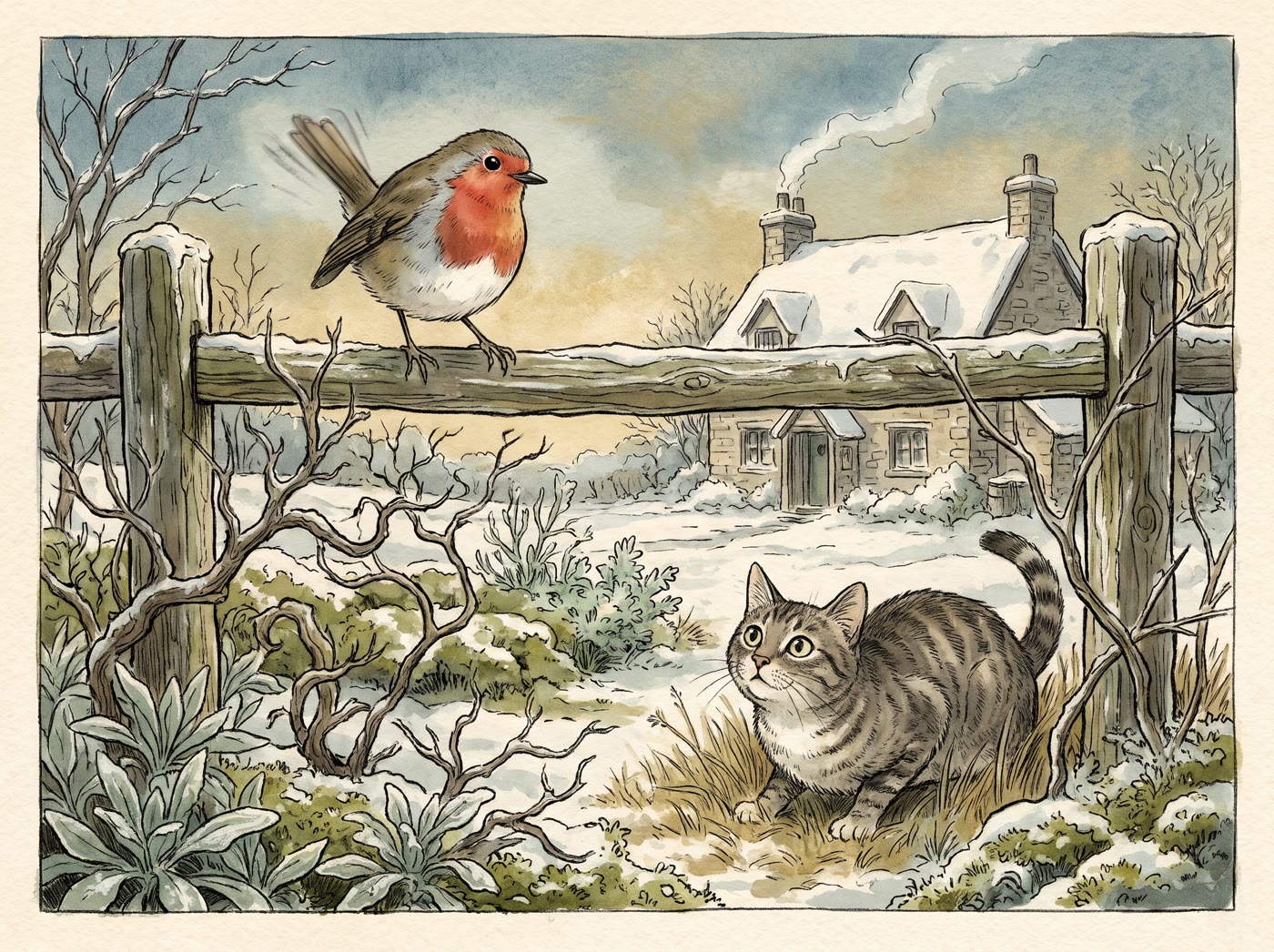
Little Robin Redbreast
Sat upon a rail;
Niddle noddle went his head,
Wiggle waggle went his tail.
Little Robin Redbreast sat upon a tree,
Up went pussy-cat, and down went he;
Down came pussy-cat, and away Robin ran;
Says little Robin Redbreast, “Catch me if you can.”
Little Robin Redbreast jumped upon a wall,
Pussy-cat jumped after him, and almost got a fall;
Little Robin chirped and sang, and what did pussy say?
Pussy-cat said “Mew,” and Robin flew away.
Where the rhyme comes from
The earliest printed text is in Tommy Thumb’s Pretty Song Book, published in London in 1744 and printed by Mary Cooper. There it is called “Robbin red breast”, and it is a single short verse. The robin’s head goes “niddle, noddle” just as it does today, but the last line is a cheeky joke at the bird’s expense, one the nursery has long since dropped. We won’t repeat it here.
What happened next is the real interest of the rhyme. By the late eighteenth century the final line had been swapped for a harmless “And wag went his tail”. Peter and Iona Opie, in The Oxford Dictionary of Nursery Rhymes, treat it as one of the clearest cases of a rhyme being edited for the nursery, and the “wiggle waggle” ending sung today is one of the variations that followed. Variant wordings survive — some books print “and waggle went his tail” — and all are legitimate.
The cat-and-robin verses are a separate strand. They turn up in nineteenth-century collections, including an American Mother Goose of 1833 and Charles Welsh’s A Book of Nursery Rhymes of 1901, with small differences in wording from book to book. When they first appeared is not known. Searchers will often find a further short fragment beginning “came to visit me” run on from the rail verse; the Opies recorded it as a fragment, but we have not traced its date, so we have left it out. It is not part of the verses above.
What does it mean?
No meaning is recorded. The rhyme is a small comic sketch of a bird on a rail, and then a bird and a cat in a game of chase. We found no evidence for any symbolic reading, so any you come across is guesswork rather than history. Its real story is the quiet one: how a rude joke from 1744 became a nursery favourite by being gently rewritten.
Sharing it with children
The short verse makes a good finger play, and a version with hand actions was printed in a children’s anthology as long ago as 1920. Make a bird of one hand and perch it on the forefinger of the other. Nod it on “niddle noddle”, then wag the little finger from side to side for the tail on “wiggle waggle”. With a younger child, simply nod your own head and wiggle your hips and let them copy.
The cat verse suits a chase game. One person is the robin and one the cat; the robin “sits” on a cushion for the tree, the cat creeps up, and the chase begins on “Catch me if you can”. Stop on “Mew” and let the robin flit away. On a cold day, put out some seed and watch for a real robin: see whether it nods its head and flicks its tail the way the rhyme says.
Extra verses to sing
These verses aren’t traditional — they’re ours. They follow the rhythm of the short rail verse.
Little Robin Redbreast
Sat upon the gate;
Niddle noddle went his head,
Hop and skip went his mate.
Little Robin Redbreast
Sat upon the snow;
Niddle noddle went his head,
Flutter, flutter, off he’d go.