Lucy Locket
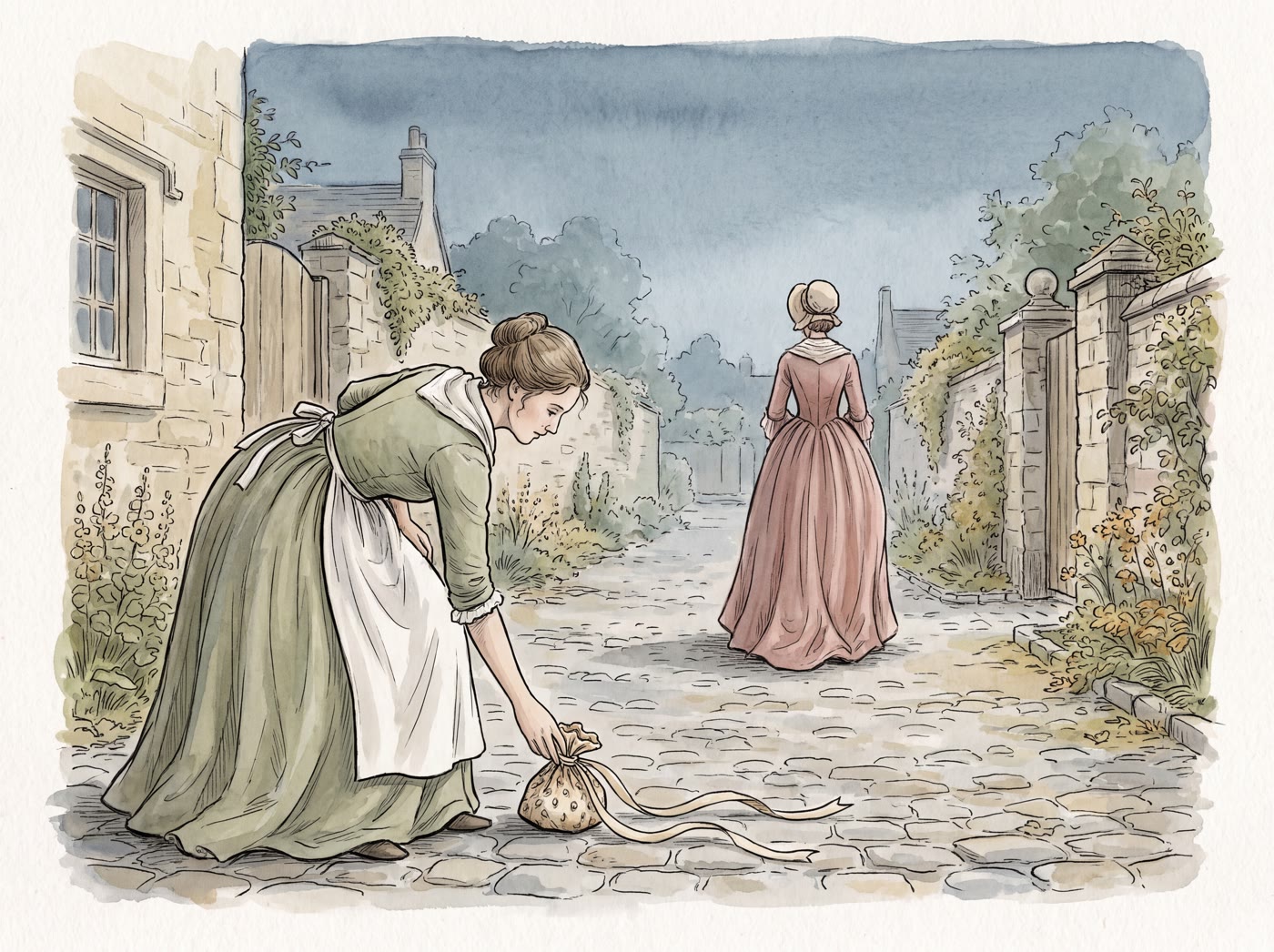
Lucy Locket lost her pocket,
Kitty Fisher found it;
Not a penny was there in it,
Only ribbon round it.
Where the rhyme comes from
Lucy Locket was first recorded in print in James Orchard Halliwell’s The Nursery Rhymes of England (1842), and it is catalogued in the Roud Folk Song Index as number 19536. The rhyme was evidently in circulation earlier: the Opies, in their Oxford Dictionary of Nursery Rhymes, note evidence that it was popular in Britain and America at least in the early nineteenth century. No earlier printing has been found, so “first recorded” is as far as the evidence goes — the date it was made up is not known.
The last two lines vary. Besides the version above you will meet “Just a ribbon ’round it”, “Nothing in it, nothing in it, / But a binder round it”, and an older “Except the binding round it”. One version is often sung to the tune of “Yankee Doodle”, though it is not clear whether those words or Lucy Locket’s came first, and many classroom versions use a different, simpler tune altogether.
A word on the pocket. In the eighteenth century a woman’s pocket was not sewn into her clothes. The V&A describes tie-on pockets as separate pouches tied around the waist by a tape and reached through slits in the gown and petticoats; they were in common use from about 1650 to the end of the nineteenth century, and the V&A notes newspaper adverts for lost ones. The museum says nothing about the rhyme, but this, in our reading, is why the story makes sense: a pouch on a tape could come off, be lost and be found, and the “ribbon round it” would be the pocket’s own tie.
What does it mean?
Perhaps nothing more than it says: a lost pouch, a finder, and a small joke that the finder is disappointed. If you have searched for what Lucy Locket is “really” about, or what happened to her, the honest answer is that we do not know.
Two rival courtesans. The oldest suggestion, made by Halliwell, is that Lucy Locket and Kitty Fisher were two celebrated courtesans of the time of Charles II. The Opies report that no supporting evidence has been found. There is also a problem with the dates: the best-known Kitty Fisher, a celebrity painted by Joshua Reynolds, lived from 1741 to 1767, more than half a century after Charles II died in 1685. She may be the Kitty of the rhyme, or the name may simply have been borrowed from her fame; no source shows which. The popular modern tale of a rivalry between her and a real “Lucy”, in which the pocket stands for a wealthy admirer, is a retelling with no evidence behind it that we could find.
The Beggar’s Opera. A similar name appears in John Gay’s The Beggar’s Opera (1728), but the Opies think the name may already have been proverbial. No link between the play and the rhyme has been shown.
Sharing it with children
Hide the pocket. This is a modern music-class game, not a traditional one, and it is widely used by Kodály-inspired teachers to teach the note la — though that is a teaching habit, not a “Kodály song”. One child leaves the room (or closes their eyes) while a small purse or pouch is hidden. The seeker returns and the class sings, getting louder as the seeker draws near and softer as they move away. A child can be “Kitty Fisher” and do the hiding, with another as “Lucy Locket” doing the looking. It is a gentle way to talk about loud and soft.
March and clap. Our own suggestion: march on the spot, taking one step for each beat. Clap on “pocket”, “found”, “penny” and “ribbon”, then hold out empty hands at the end of line three, as Lucy’s pocket turns out to be empty. Older children can tie a ribbon to a small bag and take it in turns to drop it for a friend to find.
Extra verses to sing
These verses aren’t traditional — they’re ours. Sing them when the hunt needs a few more rounds.
Lucy Locket lost her thimble,
Kitty Fisher found it;
Nothing else was there beside it,
Just a thread around it.
Lucy Locket lost her button,
Kitty Fisher found it;
Lucy laughed and gave a curtsey,
Sewed it back and wound it.