Peter, Peter, Pumpkin Eater
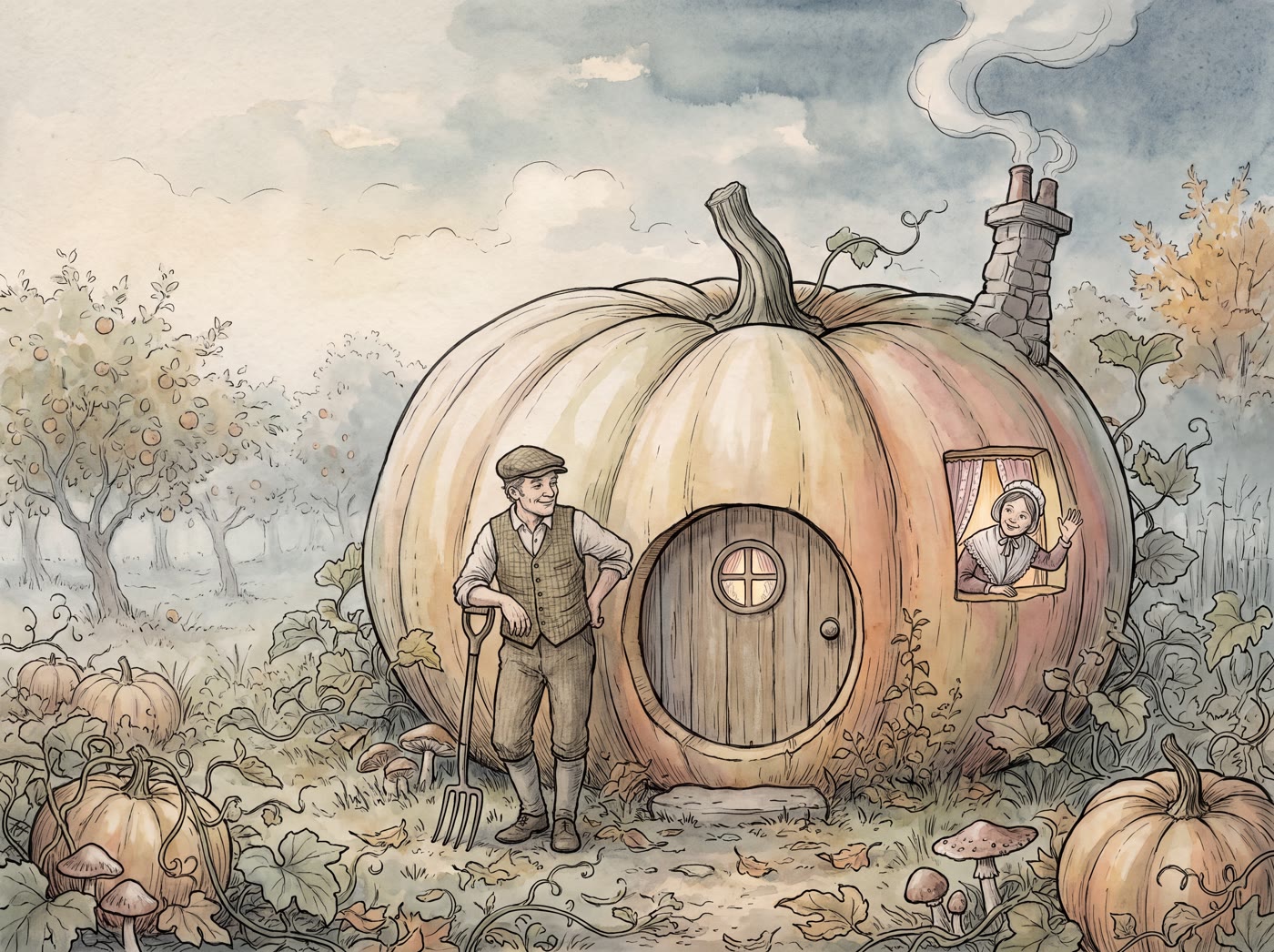
Peter, Peter, pumpkin eater,
Had a wife but couldn’t keep her;
He put her in a pumpkin shell
And there he kept her very well.
Peter, Peter, pumpkin eater,
Had another and didn’t love her;
Peter learned to read and spell,
And then he loved her very well.
Where the rhyme comes from
Nobody knows who wrote it. The earliest printing that Iona and Peter Opie found is in a London book of around 1797 with a gloriously long title: Infant Institutes, part the first: or a Nurserical Essay on the Poetry, Lyric and Allegorical, of the Earliest Ages, attributed to Noel Turner. The book contains the rhyme; it is not evidence that Turner made it up.
The rhyme then crosses the Atlantic. Its earliest American appearance is in a Boston collection, Mother Goose’s Quarto: or Melodies Complete, published about 1825, and the Oxford English Dictionary takes its first example of the word “pumpkin-eater” from Mother Goose’s Melodies of 1833, which opens “Peter, Peter, pumpkin eater, / Had a wife and couldn’t keep her”. Both “and” and “but” are still in use. The second verse, in which Peter learns to read and spell, is traditional too, but when it joined the first is not known. Some modern printings give its second line as “Had another and didn’t leave her”. The Roud Folk Song Index files the rhyme as number 13497, a number it shares with a chimney-sweeper relative.
That relative causes confusion. “Eeper Weeper” (sometimes “Eaver Weaver”) is a chimney-sweeper skipping rhyme that echoes Peter’s second line, but it is recorded only from the early twentieth century — a century after the 1797 printing — and there is no evidence that it is the ancestor it is sometimes said to be. Older is a verse from Aberdeen, published in 1868, which begins “Peter, my neeper” — neeper meaning neighbour — and has no pumpkin in it at all. The Opies regarded it as an older form of the chimney-sweeper rhyme.
What does it mean?
Read as it stands, it is a small comic story in two parts. Peter’s wife will not stay put, so he finds her a home she is content with — a pumpkin shell, which children readily picture as a snug little house with a door and a window. In the second verse a husband is improved by learning to read and spell. Beyond that, the honest answer is that nobody knows what, if anything, it was first meant to say.
The murdered wife. Search for the rhyme’s “dark meaning” and you will be told that Peter killed an unfaithful wife and hid her in the pumpkin. This is modern speculation, repeated from listicle to video, and nothing in the early printed texts supports it: the versions of 1797, the 1820s and 1833 say nothing of the kind. The only grim early text is that pumpkin-less Aberdeen verse of 1868, in which the wife is put in a wall — but nothing shows that it explains the pumpkin rhyme.
“Cheater, cheater, pumpkin eater”. The rhyme also lives on as a playground taunt, and that is sometimes taken as proof that Peter’s story is about cheating. It is not. The taunt is a modern spin-off, borrowing the rhyme’s sound for the word “cheater”, and the earliest example found in print is from 1992, in an American newspaper, the Gaffney Ledger of South Carolina. It tells us how children play with the rhyme now, not what it meant two centuries ago.
Sharing it with children
Pumpkin season is the natural moment for this one. If you are scooping out a pumpkin anyway, stop when the shell is hollow and say the rhyme with the real thing in front of you — then cut a small round door and a window, and find a toy or a peg doll to live inside. Children will happily decide whether Peter’s wife likes her new house, and what she would put in it.
The rhyme’s strong, even beat makes it good for clapping: one clap on each “Pe-” and “pump-”, and a pat on the knees for “very well”. Once it is known, try it as a spoken round, a second group starting the first line as the first group reaches “pumpkin shell”. And the second verse is a gift to anyone teaching reading: Peter has to learn to read and spell before things go right, which gives a new reader something to be proud of.
Extra verses to sing
These verses aren’t traditional — they’re ours. Say them once the pumpkin house is built.
Peter, Peter, pumpkin eater,
Swept his pumpkin, made it neater;
Cut a window, round and bright,
To let the moonshine in at night.
Peter’s wife, when spring came round,
Sowed some seeds in garden ground;
Now there are pumpkins, row on row,
And room for all their friends, you know.