Row, Row, Row Your Boat
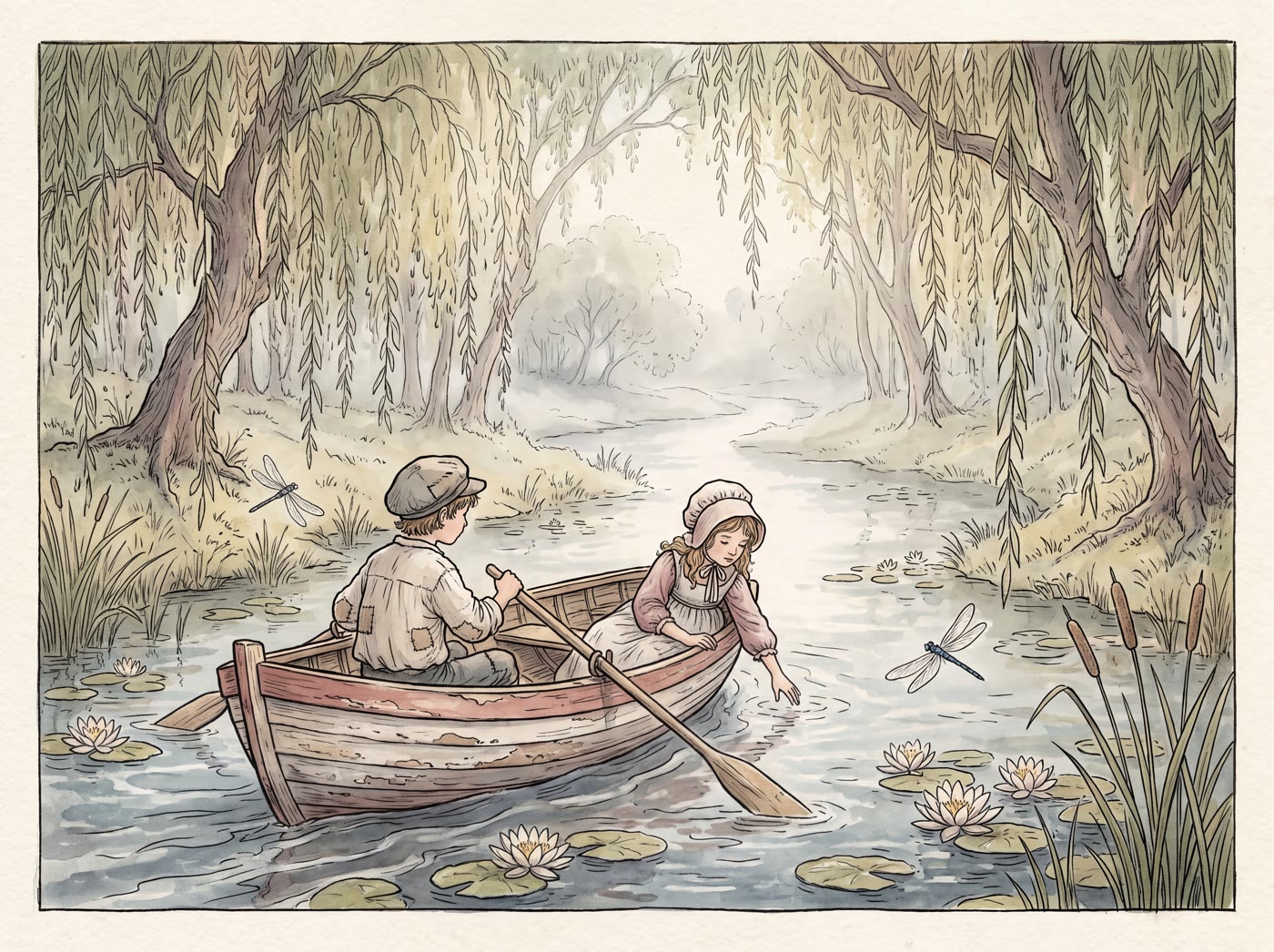
Row, row, row your boat,
Gently down the stream,
Merrily, merrily, merrily, merrily,
Life is but a dream.
Where the rhyme comes from
Row, Row, Row Your Boat is a nursery song of American origin, and often sung as a round. The Roud Folk Song Index lists it as number 19236. Who wrote the words is not known.
The earliest printing yet traced dates from 1852, in America, with words close to those sung today but set to a very different tune; two years later, in 1854, the same words were printed again to yet another tune. The year rests on Studwell’s The Americana Song Reader (1997), but the name of the 1852 publication itself has not been identified in any source we could find — so we give the year and leave it there.
The melody everyone knows arrives later. It was first printed with the words in 1881, in The Franklin Square Song Collection, published in New York, where it is credited to Eliphalet Oram Lyte (1842–1913). Lyte was a Pennsylvania teacher, textbook author and principal of the Millersville State Normal School — a schoolman rather than a composer by trade — and the collection does not make clear whether he composed the tune or adapted an existing one. He is often named flatly as its composer; “credited with” is as far as the evidence goes.
What does it mean?
A rowing song with a dreamy last line. On the surface there is nothing hidden at all: a boat, a stream, an easy stroke, a run of “merrily”s that bob along like the oars. Then the final line, “Life is but a dream”, turns the little song unexpectedly wistful, and that turn is what has kept people wondering about it.
The “deeper” and “dark” meanings. Search for the meaning of this song and you will find it read as a Buddhist meditation on impermanence, a philosophy of going with the flow, or — in videos promising a shocking secret — something darker still. These readings are modern commentary, much of it from forums, videos and personal essays. None of it is evidence about why the song was written. The author of the words is unknown, no statement of intent survives, and no source ties that last line to any philosophy at the time it was written. Finding something to think about in that last line is perfectly reasonable; presenting it as a hidden original meaning is not.
The crocodile. Many children know a second verse ending “If you see a crocodile, / Don’t forget to scream!” It is sung in playgrounds, libraries and nurseries on both sides of the Atlantic, with no known author, and alongside it a whole menagerie of anonymous variants with other animals and other noises. It is a modern addition, not part of the traditional song — and a lively example of the folk process still at work.
Sharing it with children
The classic way to share it with a very small child is the rowing game. Sit facing each other on the floor, legs out, holding both hands, and rock back and forth on the beat — one of you leaning back as the other leans forward, like two people pulling on the same pair of oars. A baby can ride the same rocking on your lap, facing you.
Once the tune is secure, try it as a round, which is how it is made to be sung. Split into two groups. The first group starts; when they reach “Gently down the stream”, the second group begins again from “Row, row, row your boat”. Each group sings the verse through two or three times and drops out in turn, so the song ends with one voice alone. With three or four groups, each entering a line after the last, the lines interweave. That simple overlap, easy enough for young voices, is what has made it a classroom staple.
Play with the speed as well: a slow, sleepy row on a calm river, then a fast one through choppy water, then slow again. And for a game that can run all afternoon, change the vehicle — “Drive, drive, drive your car, / Slowly down the street” — and let the child choose the next one, finding a line to finish it and an action to go with it.
Extra verses to sing
These verses aren’t traditional — they’re ours. Sing them when the boat needs bringing home.
Row, row, row your boat,
Gently to the shore,
Merrily, merrily, merrily, merrily,
Then we’ll row some more.
Row, row, row your boat,
Underneath the moon,
Merrily, merrily, merrily, merrily,
Hum a sleepy tune.