Simple Simon
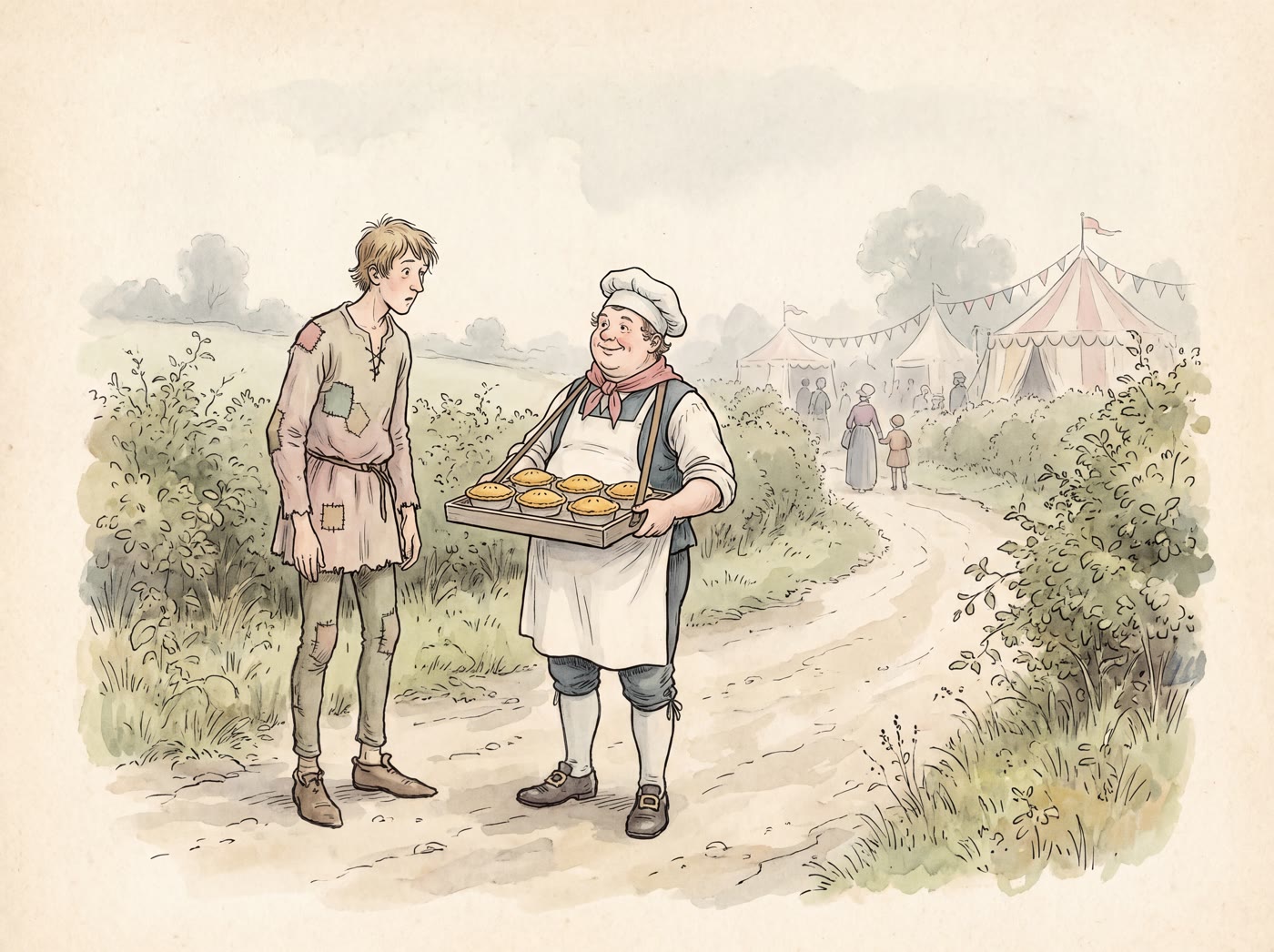
Simple Simon met a pieman,
Going to the fair;
Says Simple Simon to the pieman,
Let me taste your ware.
Said the pieman to Simple Simon,
Show me first your penny;
Says Simple Simon to the pieman,
Indeed I have not any.
Simple Simon went a-fishing,
For to catch a whale;
All the water he had got
Was in his mother’s pail.
Simple Simon went to look
If plums grew on a thistle;
He pricked his fingers very much,
Which made poor Simon whistle.
Where the rhyme comes from
The four verses above are only the opening of something longer. The Opies, in The Oxford Dictionary of Nursery Rhymes, trace them to a chapbook history of Simple Simon published in 1764, of which the rhyme is the first part. Longer versions go on to describe further foolish adventures, and the wording varies from one printing to the next: the second stanza ends “Indeed I have not any” in some books and “Sir, I haven’t any” in others. We have given the first. The rhyme is catalogued as Roud 19777.
The character himself may be older than the rhyme, possibly through an Elizabethan chapbook and a ballad of about 1685, Simple Simon’s Misfortunes and his Wife Margery’s Cruelty. That is a possibility rather than a proven line of descent: nothing we have seen shows that the ballad is the source of the rhyme.
A real-life model has also been suggested — Simon Edy, an eighteenth-century beggar of the St Giles district of London — though that is speculation at most.
What does it mean?
Less than the internet would like. “Simple” here means foolish or naive, and the rhyme is a comic tale of a simpleton who does not grasp basic common sense. Everything Simon does goes wrong in a way the listener can see coming: he asks for a pie without any money, goes fishing for a whale with only his mother’s pail, and hunts for plums on a thistle.
A lesson in common sense. The rhyme is often read as a light-hearted cautionary tale about manners and good sense — “don’t be like Simon”. That is a modern interpretation. Nothing records that anyone meant it as a lesson, and no hidden meaning or concealed history has been recorded for the rhyme. It was meant to be funny, and it still is.
A pieman, as the rhyme makes plain, is a man selling pies, and here he is on his way to the fair.
Sharing it with children
Run a pie stall. Set up a table with a tray of play pies — or real mince pies, or paper plates — and take turns as pieman and Simon. The pieman holds out a hand for the penny; Simon pats his pockets and delivers the line with as much dismay as he can manage. It pairs happily with the bun stall in Hot Cross Buns, so a small market can have both.
Count the pennies. Give the pieman a pot of coins or buttons and let the customers pay properly. Count the pennies out one at a time, then try paying for two pies, or three. Children who have just watched Simon fail can enjoy being the customer who has plenty.
What silly thing did Simon do next? Stop after any verse and ask for the next foolish adventure. Where would he go looking for apples, and what would he try to carry home in his hat? Children are usually ahead of the adults at this. Keep it to the same four-line pattern if you can, so the answers can be sung rather than just said.
Extra verses to sing
These verses aren’t traditional — they’re ours. Sing them alongside the old ones, or use them to start your own.
Simple Simon went to market,
Pockets full of air;
When the pieman asked for pennies
Simon said, “Not there!”
Simple Simon, once more hungry,
Found a penny in his shoe;
Bought a pie, and ate it slowly —
That was the wisest thing he knew.