The Queen of Hearts
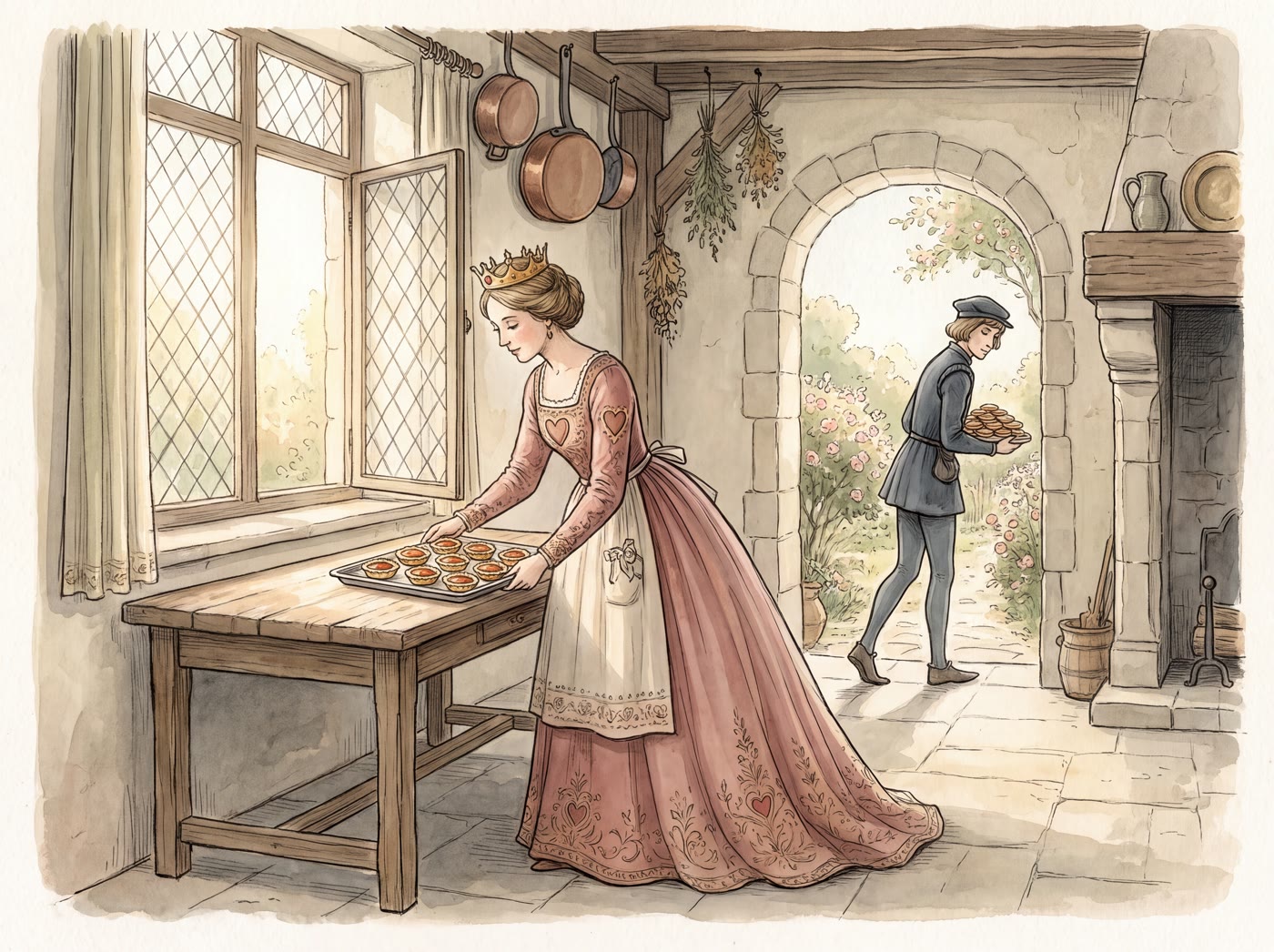
The Queen of Hearts
She made some tarts,
All on a summer’s day;
The Knave of Hearts
He stole those tarts,
And took them clean away.
The King of Hearts
Called for the tarts,
And beat the Knave full sore;
The Knave of Hearts
Brought back the tarts,
And vowed he’d steal no more.
Where the rhyme comes from
Many adults first met the Queen of Hearts and her tarts in Alice’s Adventures in Wonderland, but the nursery rhyme is older than the book by well over eighty years. It first appeared in print in The European Magazine, and London Review in April 1782, in a column of miscellaneous scraps called “The Hive”. It was anonymous, and it was printed in a magazine for adult readers, not in a book for children.
The 1782 words differ a little from the ones we say today. The knave “stole those tarts, / And with them run away”; the king “Call’d for those tarts”; and at the close the knave “said he’ll ne’er steal more”. The story is the same, and so is its shape.
The 1782 poem was also longer. It ran on through all four suits of a pack of cards — hearts, spades, clubs and diamonds — with a king, a queen and a knave behaving badly in each. The other three stanzas involve kissing, wife-beating and a threatened hanging. They are adult in tone and did not survive into the nursery, so only the hearts stanza is sung to children. The Opies, in their Oxford Dictionary of Nursery Rhymes, argued that the other suit stanzas were later additions to an older poem, which would make the hearts verse older than its first printing. That is a possibility, not something anyone has been able to show: 1782 is simply the earliest printing known.
What does it mean?
A card-table comedy. The rhyme is built from the court cards of a pack: a king, a queen and a knave. The 1782 poem, with a stanza for each suit, makes the playing-card setting plain. Read this way, it is a small domestic story about a royal household: a baker, a thief and an angry king.
Hearts and tarts. The playing-card historian W. Gurney Benham thought the rhyme was “founded on nothing more than the fact that ‘hearts’ rhymes with ‘tarts’”. It is the plainest explanation and the best supported. Nothing in the rhyme demands a hidden story.
A real queen? One early-twentieth-century writer, Katherine Elwes Thomas, claimed that the King and Queen of Hearts were Elizabeth of Bohemia and her husband, and that the rhyme records the events leading to the Thirty Years War. We have found no evidence for this, and it should be treated as speculation.
Lewis Carroll’s Queen. It is worth keeping the rhyme and the book apart. In the rhyme the Queen of Hearts does nothing worse than bake. The furious, head-collecting queen is Carroll’s invention: in chapter VIII of Alice’s Adventures in Wonderland (1865) she is a tyrant at the croquet ground, forever shouting “Off with her head!”, while the King is mild and timid and the Knave carries the King’s crown on a cushion. In chapter XI, “Who Stole the Tarts?”, the Knave stands in chains in court with a dish of tarts on the table, and the White Rabbit reads out the first stanza of the rhyme as the accusation, with small changes of Carroll’s own — “summer day” for “summer’s day”, and “took them, quite away” for “took them clean away”. Carroll borrowed the crime; the bad temper is his.
Sharing it with children
Who stole the tarts? Cut a handful of paper tarts from card, or bake real ones, and hide them around the room while the “Queen” is out. Say the first verse together, then let the children hunt for the stolen tarts. Whoever finds the last one takes the next turn as Queen.
Paper tarts. Round paper cases, a dab of red paint for jam and a small paper heart on top make a good quiet-time craft. Count them onto a plate as you go.
Sorting the court. Take the twelve court cards from a pack and lay them out. Can the children find the King, Queen and Knave of Hearts? Then sort the rest by suit, and see which suits have a whole royal family together.
The line about beating the Knave is part of the traditional words, but there is no need to dwell on it with small children. A mock scolding with a wagging finger, and a very sorry Knave, will do.
Extra verses to sing
These verses aren’t traditional — they’re ours. Sing them if you would like the tarts to end up shared.
The Queen of Hearts
Made some more tarts,
And set them out with care;
The Knave of Hearts
Passed round the tarts,
So everyone had a share.
The King of Hearts
Ate two small tarts,
And licked his fingers clean;
The Knave of Hearts
Washed the tins for tarts,
The tidiest knave ever seen.