Captain Crackskull Cracked a Catchpole’s Cockscomb
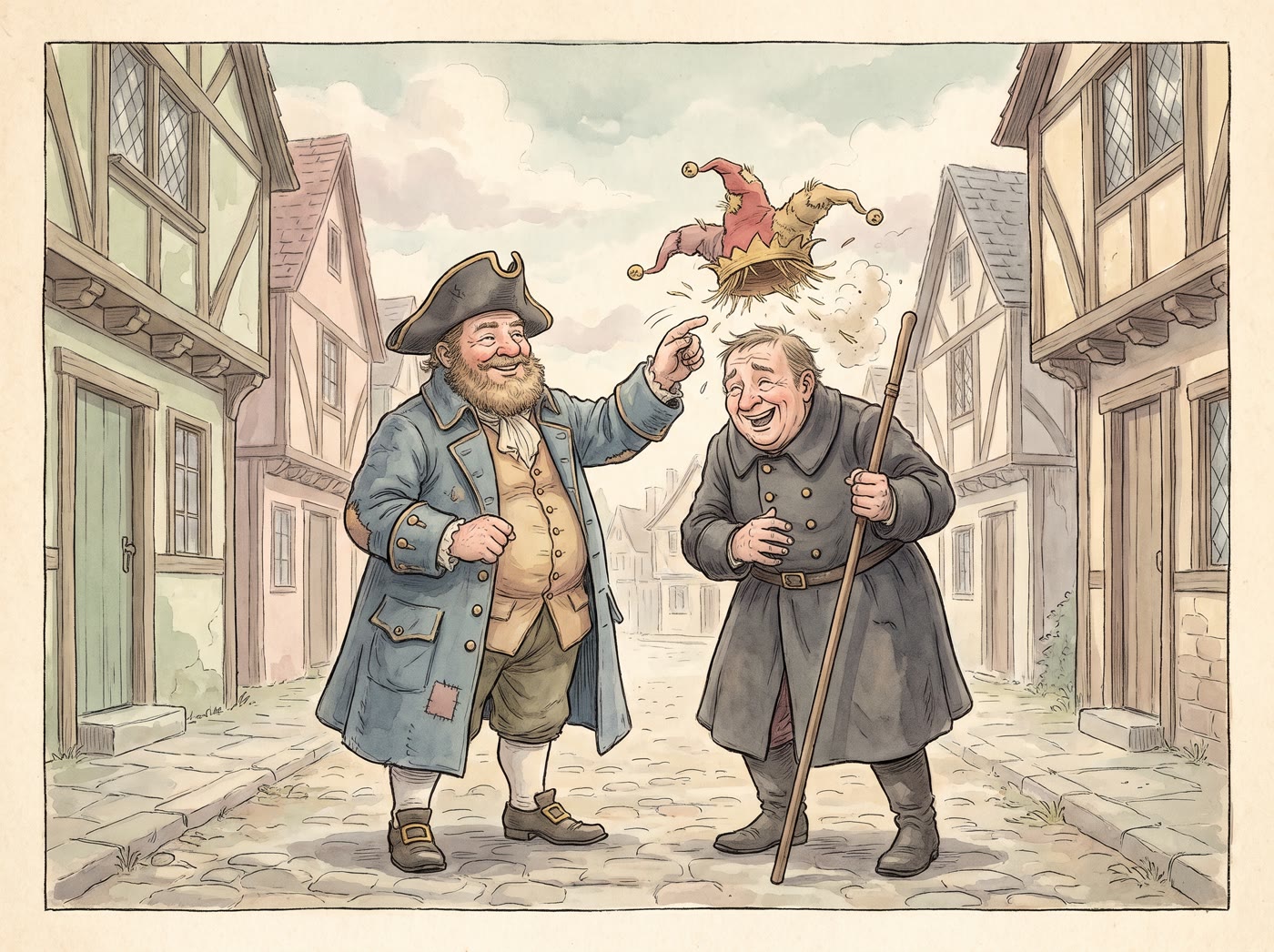
Captain Crackskull crack’d a Catchpoll’s Cockscomb:
Did Captain Crackskull crack a Catchpoll’s Cockscomb?
If Captain Crackskull crack’d a Catchpoll’s Cockscomb,
Where’s the Catchpoll’s Cockscomb Captain Crackskull crack’d?
Where the rhyme comes from
Captain Crackskull is the C of an alphabet of tongue twisters, Peter Piper’s Practical Principles of Plain and Perfect Pronunciation. The Oxford Companion to Children’s Literature describes the book as first published by the London publisher John Harris in 1813, with one twister for each letter; we did not see an 1813 copy, and the Project Gutenberg text of the 1836 edition lists the book as anonymous. The best-known verse by far is Peter Piper and his pickled peppers.
The words above are as printed in the 1836 Philadelphia edition (Willard Johnson, South Street), as given in the Project Gutenberg text of that edition. Because we have not seen the 1813 original, we cannot promise that its wording was the same. The 1836 text spells the word Catchpoll with two ls, and gives “crack’d” in the first, third and fourth lines but plain “crack” in the second. The modern spelling of the word is usually catchpole, and that is the form we use in the title. In the same edition the Captain is the third letter, coming after Billy Button and before Davy Dolldrum.
The book’s preface, which is itself a tongue twister, says its author puts “Pen to Paper to Produce these Puzzling Pages” as a “Peculiarly Pleasant and Profitable Path to Proper, Plain and Precise Pronunciation”. It was meant as a pronunciation drill, and the verse is built to be one.
What does it mean?
What is a catchpole? Collins English Dictionary defines it as, in medieval England, a sheriff’s officer who arrested debtors. The word comes by way of Medieval Latin cacepollus, which meant a tax-gatherer and, literally, a chicken-chaser. Catchpoll is a recorded variant spelling, so the 1836 spelling is not a misprint.
What is a cockscomb? World Wide Words explains that coxcomb was once spelled cockscomb, after the serrated red crest of a rooster, which the traditional jester’s cap imitated. A cockscomb was therefore a jester or fool, and around the middle of the sixteenth century the word also became a term for the head. Which of these the verse intends is not stated anywhere we have read. Our reading is that “cracking a cockscomb” means a bump on the head, played for slapstick, which is how we have illustrated it.
Who was Captain Crackskull? Nobody knows. We have found no evidence that he or his unlucky catchpole were real people, and nothing that explains the names; like the other characters in the book, they look like names chosen to fit the letter. No source we have found says the verse meant anything beyond its sound. It follows the book’s usual pattern — a statement, a doubting question, an “if” restatement and a closing “where” — and the joke lies in the mouthful.
Sharing it with children
These are our own suggestions, not anything from the book. The sound being drilled is the hard c, the k made at the back of the tongue. Let children feel it with a finger on the throat, then try a warm-up of single words: cap, crack, cock, comb, captain. The hard parts are the clusters. In Crackskull and Cockscomb the k, s and k run together, so say each word slowly three times before joining them.
Then take the verse a line at a time at half speed. Pass it round a circle, a line each, faster on every lap, or aim for three clean repetitions in one breath. For a classroom game, give each child a paper captain’s hat and let them “flick” a scrunched-paper cap off a soft toy on the final line. Older children can act out the question lines as a comic courtroom, one playing the Captain and one the officer who wants to know where the cockscomb went. For a change of sound, try Peter Piper and its p; the other alphabet verses make a fine run of twisters to work through letter by letter.
Extra verses to sing
These verses aren’t traditional — they’re ours. Try them once the first four lines come easily.
Cook Corbett cracked a Coconut:
Did Cook Corbett crack a Coconut?
If Cook Corbett cracked a Coconut,
Where’s the Coconut Cook Corbett cracked?
Cousin Clara crunched a Carrot:
Did Cousin Clara crunch a Carrot?
If Cousin Clara crunched a Carrot,
Where’s the Carrot Cousin Clara crunched?