I Saw Esau Kissing Kate
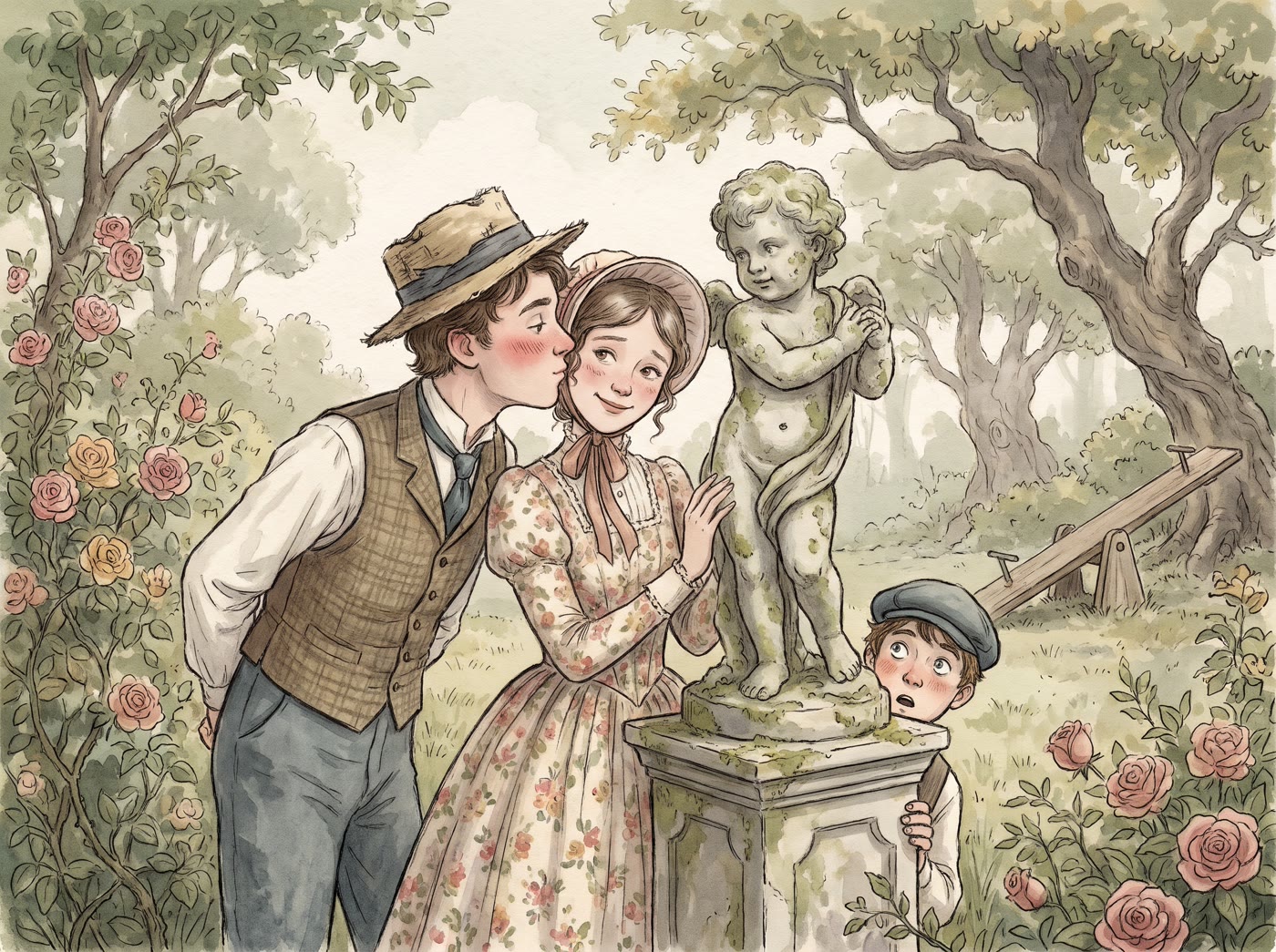
I saw Esau kissing Kate,
And the fact is we all three saw;
For I saw Esau, he saw me,
And she saw I saw Esau.
Where the rhyme comes from
The earliest version we can trace is the chorus of a comic song, The Country Cousin, or I Saw Esau Kissing Kate, with words by Harry Hunter and music by Vincent Davies. It was in print in 1870: a Glasgow Poet’s Box broadside dated 16 July 1870 gives the words, and sheet music was published the same year. The wording above is the chorus as that broadside prints it. Hunter, who managed minstrel troupes and wrote for them, died in 1906, and the song belonged to the minstrel stage rather than the music hall proper.
Was there a chant before the song? Perhaps, but we have found no evidence either way, and the song is the first appearance we can document. What is certain is that the chorus escaped from the stage. The schoolchild’s version, as Iona and Peter Opie give it, is set out in five short lines and runs “For I saw him, / And he saw me,” — and the Opies borrowed the rhyme’s name for their book of playground lore, I Saw Esau. A playground variant, “I saw Esau sitting on a seesaw,” is also widely remembered, sometimes with a finger pointed on each syllable; it is oral, and we cannot date it. (A later, unrelated song of the same name also exists.)
The rhyme was sung in America too. Laura Ingalls Wilder, in her manuscript for By the Shores of Silver Lake, has her family singing it as a round. “Pa said that was an awful lot of sawing,” she writes, and they kept going until somebody laughed.
What does it mean?
The sound joke. The whole rhyme plays on one sound. “Saw” is the past tense of “see”; it is also the second half of “see-saw”; and “Esau” is pronounced “ee-saw”. So “I saw Esau” sounds a good deal like “I see-saw”, and the lines tumble over one another. This is our reading of the wordplay rather than a scholar’s finding, but it is the obvious one. The difficulty is not a hard cluster of consonants, as in the great twisters; it is keeping “I”, “he”, “she” and “saw” straight while the same sound keeps coming round.
The story of the song. The chorus is only the end of a longer tale, and the song’s own story is a gentle one. A young man takes his sweetheart to a concert, her country cousin Esau turns up, and the narrator catches the two of them kissing. Kate explains that she and Esau played at see-saw together at school, and in the end the papers report that they are married. It is innocent courtship, nothing more, and the see-saw in it is a documented link between Esau and the playground game.
Sharing it with children
Make it a game for three. Give each child a word to point at and say: one is “I saw”, one is “he saw”, one is “she saw”. Say the third line slowly, and have each child point at the next as their turn comes. Then swap parts and go again.
For the playground form, point a finger on every syllable of “I saw Esau sitting on a seesaw” and see who loses the beat first. Then try a speed round: three clean repetitions in a row, with a stumble sending you back to the start. Or sing it as a round, as the Ingalls family did, with a second voice starting when the first reaches “Kate”.
Extra verses to sing
These verses aren’t traditional — they’re ours. Try them once the first four lines come easily.
I saw Kate feeding the hens,
And the fact is we all three saw;
For I saw her, she saw him,
And he saw I saw Kate.
I saw Esau on the seesaw,
And the fact is we all three saw;
For up I saw him, down saw he,
And she saw we both saw.