Kimbo Kemble Kicked His Kinsman’s Kettle
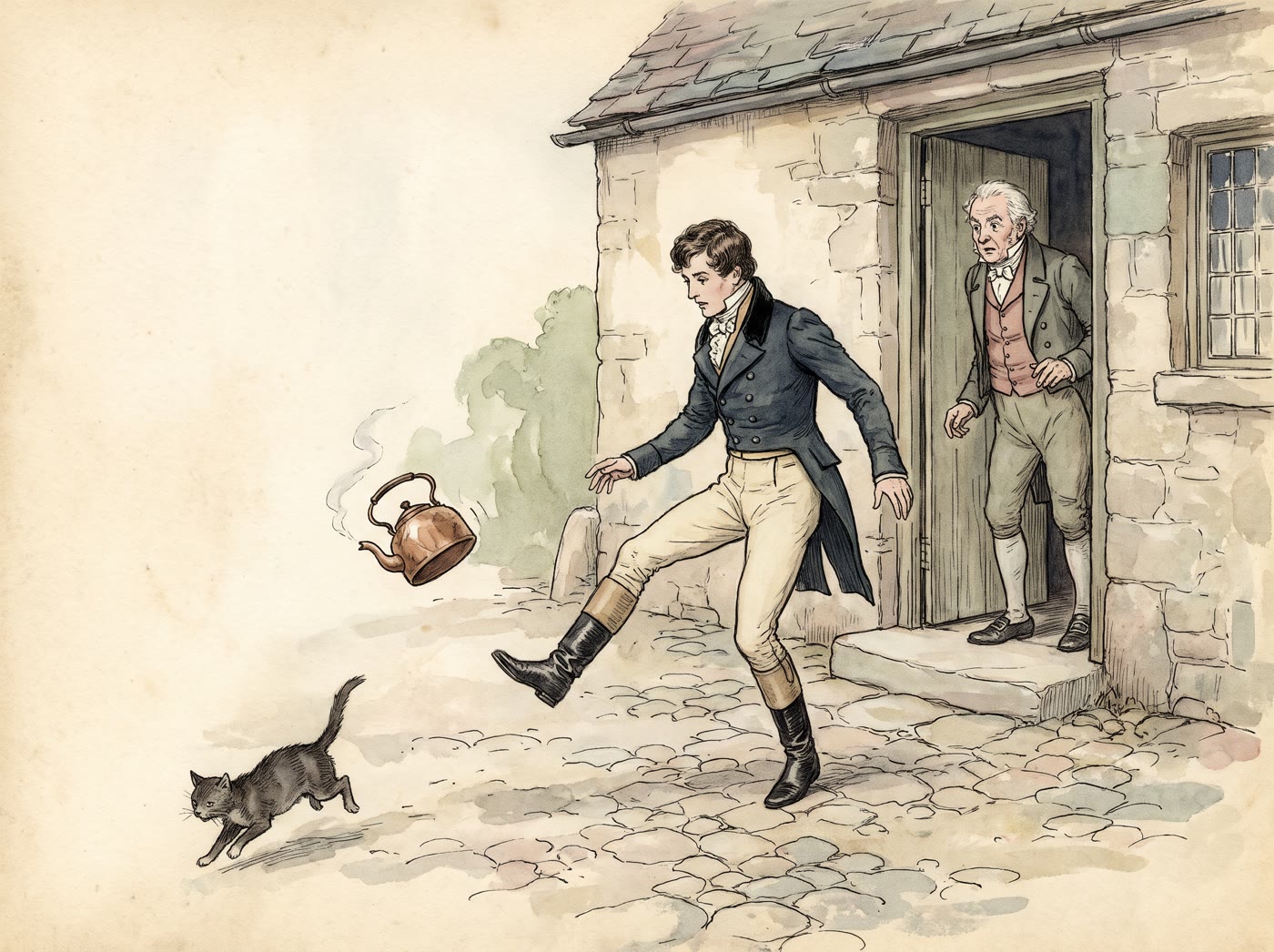
Kimbo Kemble kicked his Kinsman’s Kettle:
Did Kimbo Kemble kick his Kinsman’s Kettle?
If Kimbo Kemble kick’d his Kinsman’s Kettle,
Where’s the Kinsman’s Kettle Kimbo Kemble kick’d?
Where the rhyme comes from
Kimbo Kemble is the K of an alphabet of tongue twisters, Peter Piper’s Practical Principles of Plain and Perfect Pronunciation, published by John Harris in London in 1813, according to the Oxford Companion to Children’s Literature. The book gives one alliterative verse to each letter of the alphabet. Project Gutenberg, which holds an American edition printed in Philadelphia in 1836, lists the author as anonymous, and we have found nothing that says who wrote it; Harris is named here as the publisher only. Kimbo comes eleventh, after Jumping Jackey and just before Lanky Lawrence. The best-known entry by far is Peter Piper and his peck of pickled peppers.
The words above are those of the 1836 Philadelphia edition, which we have read in full. We have not seen the London original, so we cannot say whether the K verse looked the same in 1813. The capitals are as printed, and so is the small oddity that line one has “kicked” in full while lines three and four shorten it to “kick’d”. Printings vary a little: other copies we have glimpsed give “kick’d” in the first line as well, which is why we name the edition we quote. The 1836 text also has the full “Kinsman’s Kettle” in its last line, not just “the kettle”.
Every entry in the book is built the same way, and you can see it again in Francis Fribble, the F entry, and in Oliver Oglethorpe: a statement, a doubting question, an “if” restatement, then a closing question beginning “where”. The preface of the 1836 edition announces the purpose in the same spirit, with Peter Piper praying parents to purchase the book “Principally to Prevent the Pernicious Prevalence of Perverse Pronunciation”.
What does it mean?
Nothing that anyone can show. No source we have found says who Kimbo Kemble was, and the verse itself tells us only that he kicked a kettle. Our own inference, and no more than that, is that the name was chosen for its sound: Kimbo, Kemble, kicked, Kinsman’s and Kettle all begin with a hard k, five of them in the first line alone. The shape of the verse points the same way. It does not tell a story: it turns a statement into a question and then into a mock-logical “where is it now?”, as all the verses do, which makes it a drill rather than a tale.
The word “kinsman”. Merriam-Webster defines a kinsman as a relative, specifically a male relative, and dates the word to the twelfth century. So the kettle belongs to Kimbo’s male relation: a cousin, an uncle, a brother. The verse does not say which, or why the kettle was kicked.
Sharing it with children
The hard k is made at the back of the mouth: the back of the tongue lifts to touch the soft palate, then releases with a small puff of air. Ask a child to put a hand in front of their mouth and feel the puff as they say it. Practise the bare sound first, “k, k, k”, before any words.
Then add the mime. Kicking is pretend only: a slow, exaggerated swing of one leg at an imaginary kettle, with a “clang” at the end, makes the verse a game and keeps real kettles, and shins, safe. Take the four lines in turn: shrug for the statement, a puzzled face for the “Did...?”, a raised finger for the “If...”, and hands held out, palms up, for “Where’s the Kinsman’s Kettle?”.
For older children, make it a speed round. Say one line slowly, then ask them to repeat it twice as fast without a stumble. In our own experience of saying it, the trap is the middle of the name, where “Kimbo” slides into “Kemble”. Take turns round a circle, each person adding one line, and see who can reach “Kinsman’s Kettle Kimbo Kemble” at the end without a pause.
Extra verses to sing
These verses aren’t traditional — they’re ours. Say them in the same bouncing rhythm, and keep the kicking in the mime.
Kimbo Kemble kindly kept his Kinsman’s Kettle:
Did Kimbo Kemble keep his Kinsman’s Kettle?
If Kimbo Kemble kept it, keen and careful,
Where’s the Kettle Kimbo Kemble kept?
Kimbo Kemble carried the Kinsman’s Kettle:
Kind Kimbo Kemble carried it to the kitchen,
And the kettle came to the boil, and the kinsman cried,
“Kimbo, come and have a cup of tea!”