Francis Fribble Figured on a Frenchman’s Filly
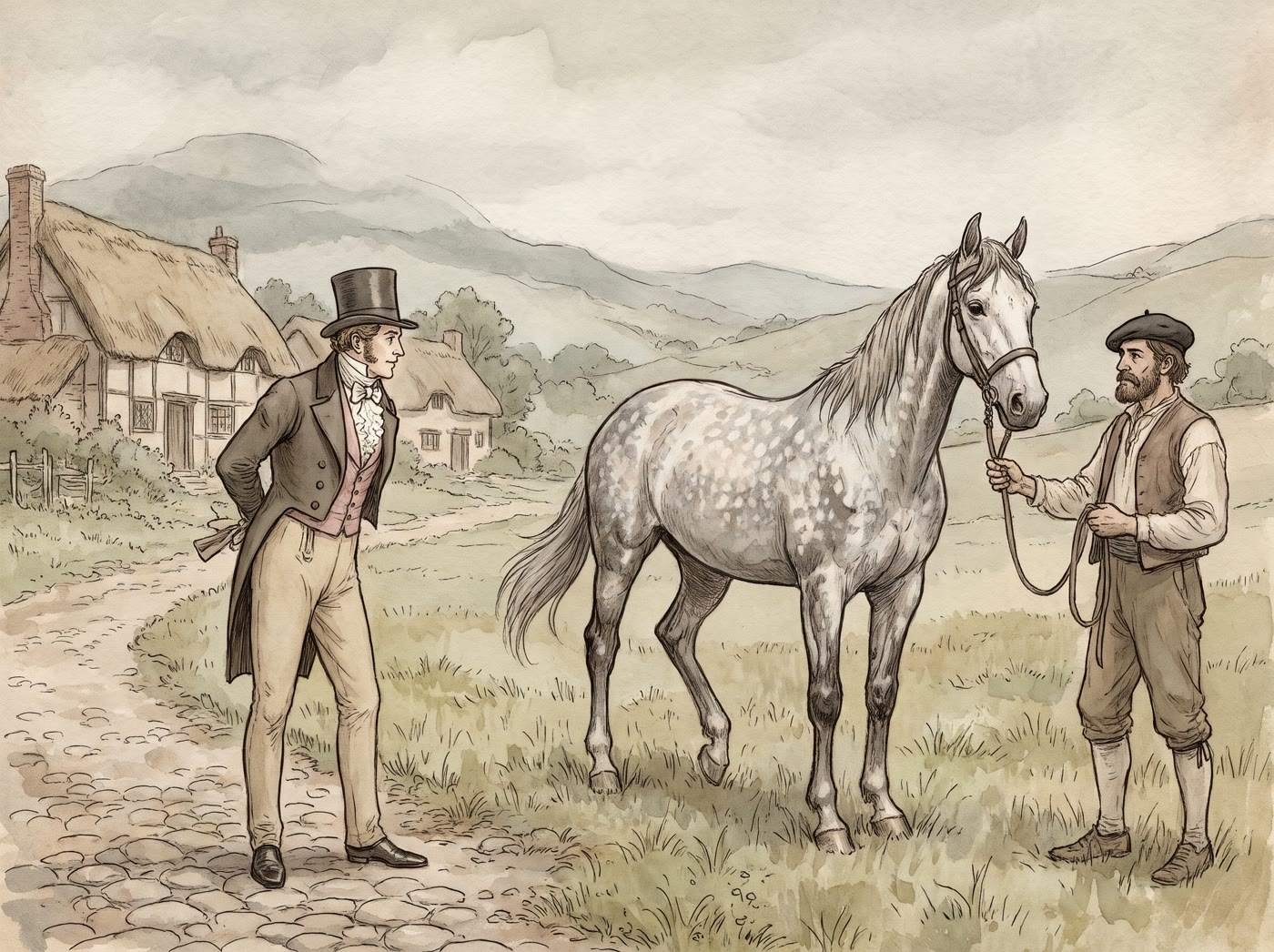
Francis Fribble figured on a Frenchman’s Filly:
Did Francis Fribble figure on a Frenchman’s Filly?
If Francis Fribble figured on a Frenchman’s Filly,
Where’s the Frenchman’s Filly Francis Fribble figured on?
Where the rhyme comes from
Francis Fribble is the F of an alphabet of tongue twisters, Peter Piper’s Practical Principles of Plain and Perfect Pronunciation. The book is usually dated 1813 and credited to the London publisher John Harris, but Project Gutenberg, which holds the 1836 Philadelphia edition, lists it as anonymous, and nothing we have found shows who wrote it. The plan is simple: one alliterative character for each letter, A to W, followed by a joint entry for X, Y and Z. The best-known entry by far is Peter Piper and his peck of pickled peppers.
The words above are the ones printed in the 1836 edition published by Willard Johnson of South Street, Philadelphia, which we have read in full. We have not read the London original, so we cannot say whether the F entry looked the same in 1813. The old capitals on Filly are as printed; many modern versions use lower case, which changes nothing but the typography.
Every entry in the book is built the same way, and you can see it again in Gaffer Gilpin, the G entry that follows this one: a statement, a doubting question, an “if” restatement, then a closing question beginning “where”. Online, the verse is often squashed into a single line. You may also meet a “Francis Fripple flicked a flippant fop” wording, which people do search for; it is not in the 1836 edition, and we have found no printing of it, early or modern, so we have not treated it as traditional.
What does it mean?
Nothing that anyone can show. We know of no real Francis behind the name, and no source tells us what the verse-maker meant by “figured on” a Frenchman’s filly. A filly is simply a young female horse, and the line works as a piece of cheerful nonsense: the point is the run of f sounds, not a story.
The word “fribble”. Wiktionary glosses fribble as a frivolous fellow or fop, or a trifler, and gives a line from Thackeray in 1852 about “a pert fribble of a peer”. So the name itself already suggests someone rather light-minded. Whether the verse-maker chose it for that reason, or only because it begins with f, is unknown.
Sharing it with children
The f sound is made by resting the top teeth against the lower lip and pushing out a breath — there is no voice in it at all. Let children feel it: hold a hand in front of the mouth and say “f, f, f” to feel the air, or hold a feather and watch it flutter. Then say “Francis”, “Fribble”, “figured”, “Frenchman’s” and “Filly” one at a time before putting them back into the line. How Now Brown Cow works the same way for a single vowel, and makes a good warm-up partner.
Because the verse is a question and answer, it is a game for two. One person asks, “Did Francis Fribble figure on a Frenchman’s Filly?” and the other answers, “Francis Fribble figured on a Frenchman’s Filly,” without a stumble. The last line asks where the filly has gone, which invites a made-up answer — a meadow, a stable, a hill.
For a speed ladder, say line one slowly, then lines one and two, then add the third, and finish with all four. Add a neigh and a hoof-clop on the word “Filly” for younger children. When this one is clean, try Oliver Oglethorpe from the same alphabet.
Extra verses to sing
These verses aren’t traditional — they’re ours. They copy the four-line pattern of the original: a statement, a doubting question, an “if”, and a question to finish.
Fiona Finch fed a Farmer’s Ferret:
Did Fiona Finch feed a Farmer’s Ferret?
If Fiona Finch fed a Farmer’s Ferret,
Where’s the Farmer’s Ferret Fiona Finch fed?
Felix Fenwick found a Fiddler’s Feather:
Did Felix Fenwick find a Fiddler’s Feather?
If Felix Fenwick found a Fiddler’s Feather,
Where’s the Fiddler’s Feather Felix Fenwick found?