My Grandmother Sent Me a Three-Cornered Handkerchief
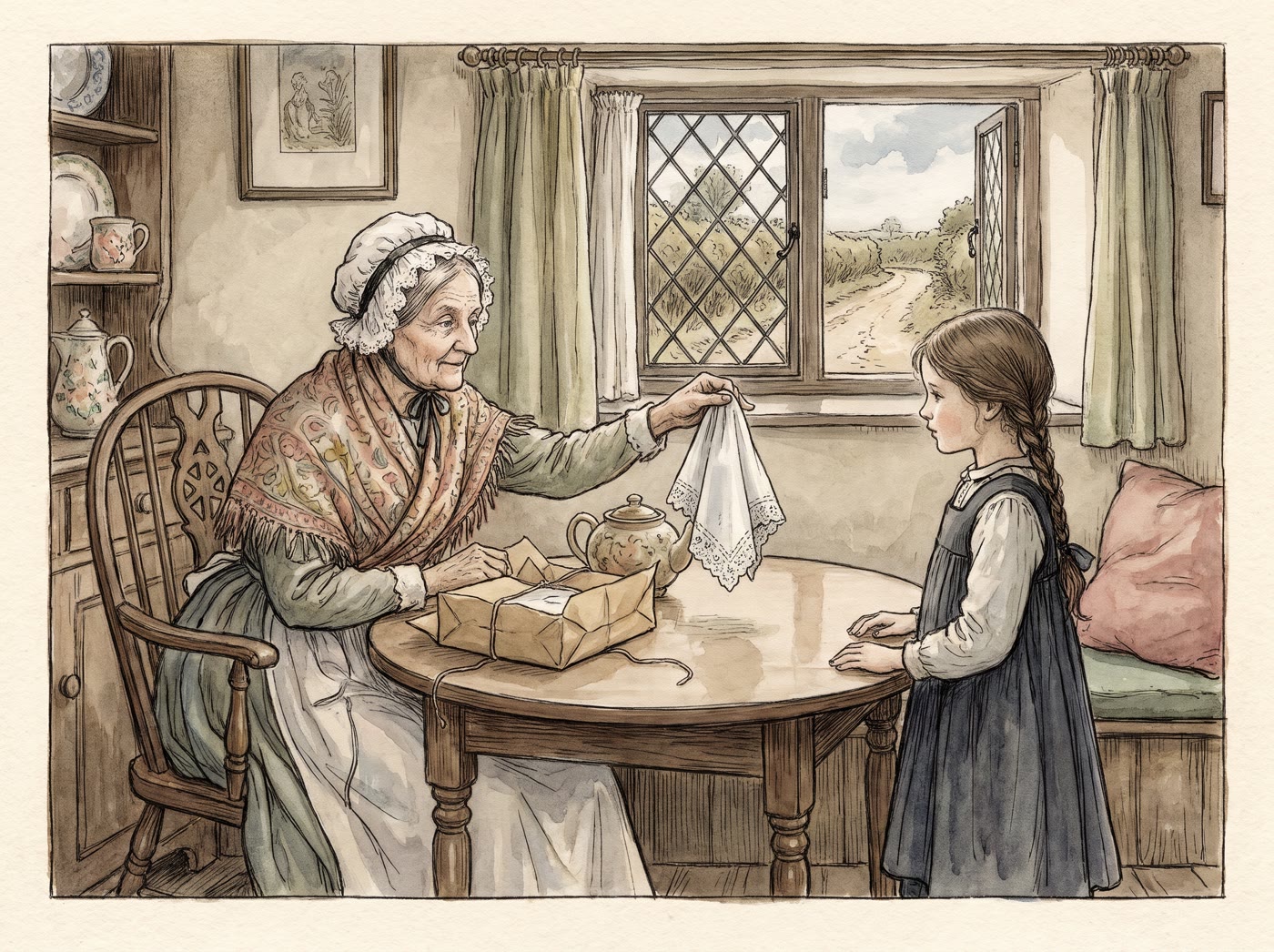
My grandmother sent me a new-fashioned three cornered cambric country cut handkerchief.
Not an old-fashioned three cornered cambric country cut handkerchief,
but a new-fashioned three cornered cambric country cut handkerchief.
Where the rhyme comes from
The firmest fact we have is a printing. The twister appears in the fifth edition of James Orchard Halliwell’s The Nursery Rhymes of England, published in 1886, as number CCXLVII. Halliwell filed it in his eighth class, “Charms”, immediately after another tongue twister, “Robert Rowley rolled a round roll round” (number CCXLVI). He gave no note on where he had it from, and nor did he say why he thought it a charm.
It does not appear in the indexes of the second (1843) and fourth (1846) editions, so it was not part of the main body of the book in its early editions. That is not the same as saying it was new in 1886: we have not checked every edition or supplement, and other earlier sources may exist. Who made it up, and when, is simply not known. We have also followed Halliwell’s printed wording above, without the hyphens that most modern copies add.
What does it mean?
Nothing hidden, as far as anyone can show. It is a tongue twister, and the fun is in the sound: the same long string of adjectives comes round three times, and the middle time it is introduced by “not an old-fashioned” instead of “a new-fashioned”. The hard k sounds of “cornered cambric country cut” keep tripping the tongue, and “new” and “old” are easy to swap by accident.
Cambric. This one has a definite answer. Cambric is a fine, closely woven, lightweight cloth, named for the French city of Cambrai. It was originally linen; later the word also came to cover cotton cloth. It was much used for handkerchiefs, and Britannica calls it ideal for them. A tale that the cloth was invented by a weaver named Baptiste around 1300 is sometimes told, but there is no historical evidence for it.
Three-cornered. This is our inference, not a documented meaning: a square handkerchief folded or cut across the diagonal makes a triangle, so “three-cornered” probably describes a triangular handkerchief, something like a neckerchief. Nothing we have found ties the rhyme to a particular garment.
Country-cut. What this meant exactly is not documented, and we have not found a dictionary that explains the phrase. It may point to a style or cut associated with the countryside, but that is a guess, and we would rather say so than invent a definition.
Sharing it with children
Start with the one-breath challenge: can you say the whole thing without stopping to breathe? Say it slowly first, with a pause after each “handkerchief”, then speed up a little each round.
The old/new swap makes a good game. One person says the first sentence; the other must supply the second, “not an old-fashioned” version, without mixing the two. A child who has mastered it can try to catch the grown-up out.
It also suits a grandparent and a grandchild reading in turns, one line each, since the words are about a grandmother’s gift. For a prop, fold a real square of cloth or a tea towel corner to corner into a triangle, and hold it up on “three cornered”. That prop is our suggestion, not a tradition.
Extra verses to sing
These verses aren’t traditional — they’re ours. Try them once the original has stopped tying your tongue.
My grandfather sent me a bright-coloured cotton cravat,
not a faded, frayed cotton cravat,
but a bright-coloured cotton cravat.
My auntie sent me a crisp, clean checked cloth cap,
not a crumpled, creased checked cloth cap,
but a crisp, clean checked cloth cap.