Villiam Veedon Vipt His Vig and Vaistcoat
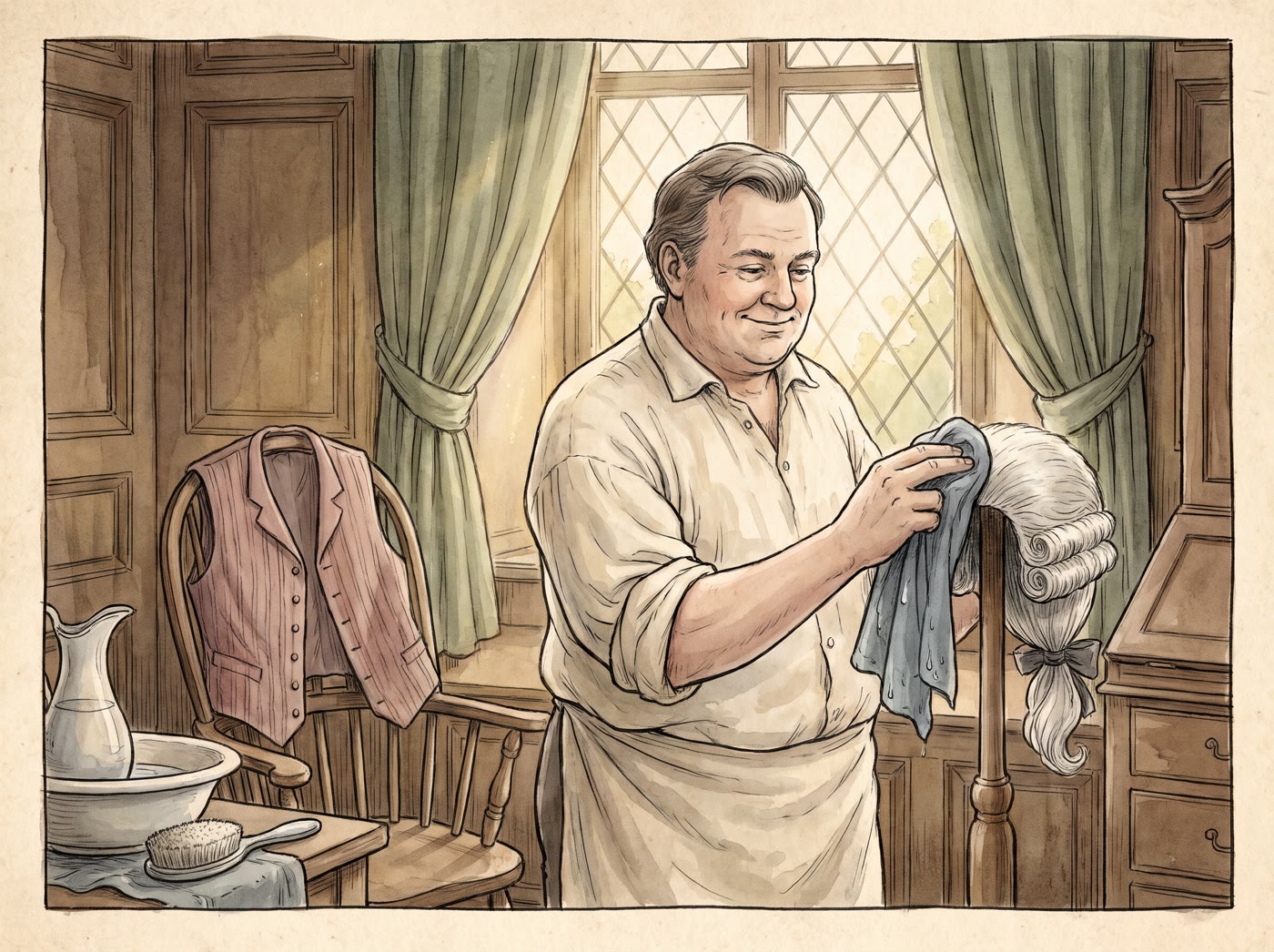
Villiam Veedon vip’d his Vig and Vaistcoat:
Did Villiam Veedon vipe his Vig and Vaistcoat?
If Villiam Veedon vip’d his Vig and Vaistcoat,
Where are the Vig and Vaistcoat Villiam Veedon vip’d?
Where the rhyme comes from
Villiam Veedon is the V of an alphabet of tongue twisters, Peter Piper’s Practical Principles of Plain and Perfect Pronunciation. The Oxford Companion to Children’s Literature describes the book as first published by John Harris in 1813, with a tongue twister for each letter of the alphabet. Harris was the publisher; we have found nothing that names an author, and one transcription of the book lists it as anonymous. The best-known verse by far is Peter Piper and his pickled peppers.
The words above are as printed in an 1836 Philadelphia edition (Willard Johnson, South Street), which we read in a scan held by the Library of Congress. We did not see the 1813 original, so we cannot promise that its wording was identical. That edition spells the verb vip’d and, in the second line, vipe; the “vipt” of this page’s title is simply a plainer way of writing the same word. In that edition Villiam comes between Uncle’s Usher and Walter Waddle. Note the last line: “Where are the Vig and Vaistcoat” is plural, as it should be, and is not a misprint.
What does it mean?
The v and w swap. Every w in the verse but one has become a v — only the closing “Where” keeps its proper letter. Villiam is William, Veedon looks like Weedon, a vig is a wig, a vaistcoat is a waistcoat, and vip’d is presumably “wiped”. These glosses are inferred from the spelling, not explained by any source we have read; “wiped” fits a wig and waistcoat best, though “whipped” cannot be strictly ruled out. (A waistcoat is what Americans call a vest.)
The Cockney joke. The swap may well be a joke about London speech. The pronouncing dictionary of John Walker (1791) lists, among the faults of London Cockneys, saying v for w and, more often, w for v — “vine and weal” for “wine and veal”. Charles Dickens gave the habit to Sam Weller in The Pickwick Papers (1836–37), whose father calls him “Samivel Veller”. Scholars who have looked at it say it was attested in the 1700s, was probably fading by the time Dickens made it a literary stereotype, and that “literary Cockney” is not necessarily what was spoken in the street. So the swap was a stock comic device of the period. But no source we have found says the author of this book intended that joke, and we would not state it as fact. It is a plausible reading, nothing more.
Who was Villiam Veedon? Nobody knows. We have found no evidence that he was a real person, and nothing that explains the name; like the other characters in the book, he looks like a name chosen to fit the letter. The verse follows the book’s usual pattern — a statement, a doubting question, an “if” restatement and a closing “where” — and the joke, such as it is, lies in the sounds.
Sharing it with children
These are our own suggestions, not anything from the book. The mouth shape is the whole lesson. For v, the top teeth rest on the lower lip; for w, the lips round into a small circle and do not touch the teeth. Let children feel the difference on a finger held to their lips, then say vine and wine, vest and west, veal and weal, vet and wet, one after the other.
Then read the verse as printed, and read it again with every w put back: “William Weedon wiped his wig and waistcoat”. Ask which version is harder to say. Take it a line at a time at half speed, then pass it round a circle a line each, faster every lap, or aim for three clean repetitions in one breath. Older children can hunt through the verse for the words that start with v in the book’s spelling and say what ordinary word each stands for. For more practice on the w sound, try Whether the Weather.
Extra verses to sing
These verses aren’t traditional — they’re ours. Try them once the first four lines come easily.
Villy Vickers vashed a Vindow:
Did Villy Vickers vash a Vindow?
If Villy Vickers vashed a Vindow,
Where’s the Vindow Villy Vickers vashed?
Vera Vane vore a velvet Vaistcoat:
Did Vera Vane vear a velvet Vaistcoat?
If Vera Vane vore a velvet Vaistcoat,
Where’s the velvet Vaistcoat Vera Vane vore?