When a Doctor Doctors a Doctor
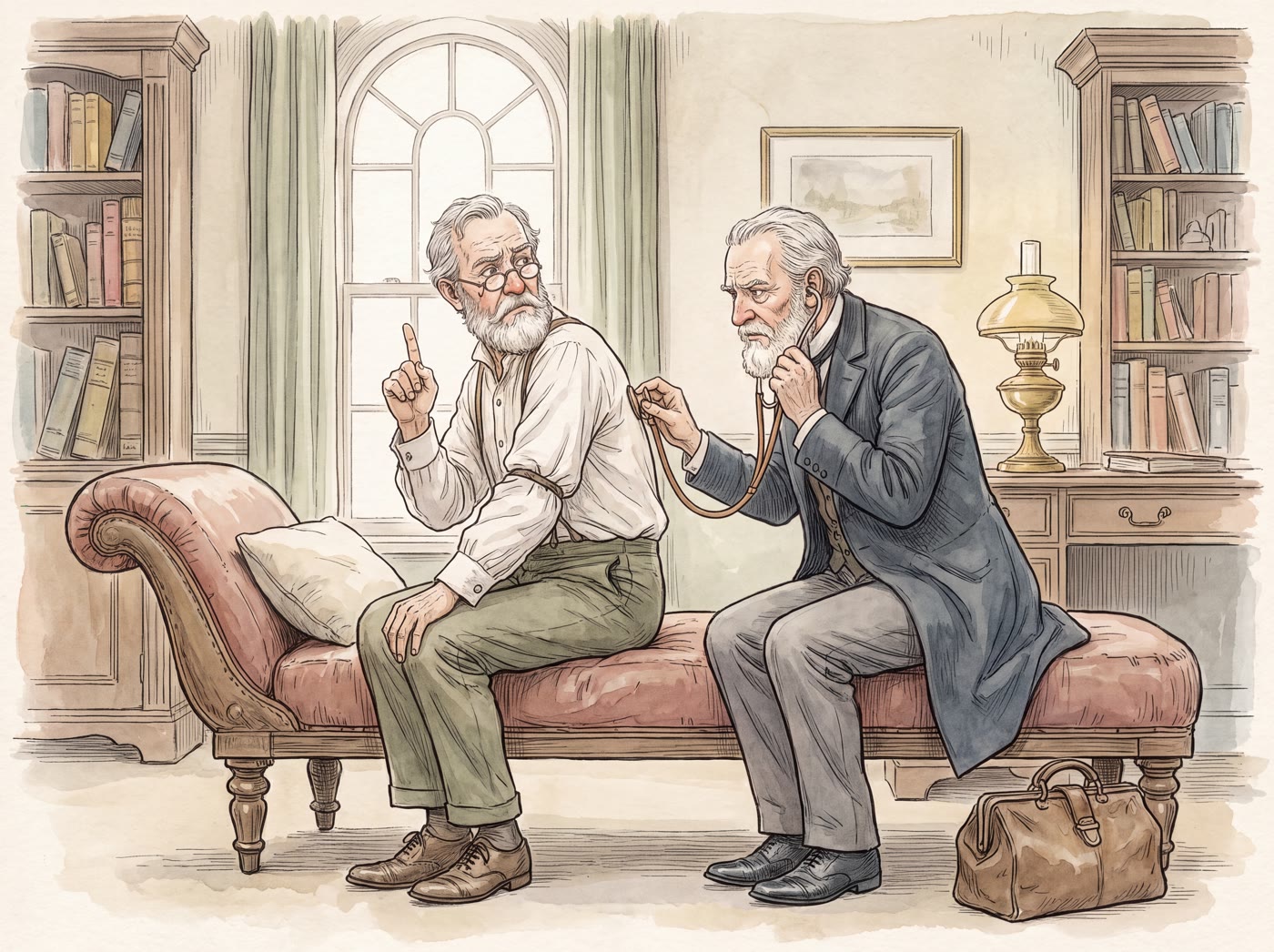
If one doctor doctors another doctor,
does the doctor who doctors the doctor
doctor the doctor the way
the doctor he is doctoring doctors?
When a doctor doctors a doctor,
does the doctor doing the doctoring
doctor as the doctor being doctored
wants to be doctored,
or does the doctor doing the doctoring
doctor as he wants to doctor?
Where the rhyme comes from
Two wordings of this doctor tongue twister are in common circulation, and both are given above. The first, beginning “If one doctor doctors another doctor”, is the one search results favoured when we looked in October 2026; the second, beginning “When a doctor doctors a doctor”, is longer and offers the poor patient a choice. Each turns up word for word in many places that have nothing to do with one another — twister collections, worksheets and handouts, video captions, language-learning apps — which is just what you would expect of a piece that has been passed from hand to hand for some time rather than made up last year. The two are best thought of as cousins, and we have found nothing to show which came first.
Who wrote it, and when, is not known. None of the sources we found names an author, and every copy we could trace is a modern reproduction with no source of its own. We have found no dated first printing, and we have not been able to check the standard printed collections of tongue twisters to see whether they include it. So we will not offer a date.
If we had to guess — and this is a guess, not a finding — we would say it is a twentieth-century piece, passed along by word of mouth and through speech drills before settling into the forms that circulate online today. That is an inference from the way it travels, not something any record shows. The honest answer is: author unknown, origin unknown.
What does it mean?
Unlike most tongue twisters, this one is not nonsense. It asks a real question, and a fair one: when a doctor falls ill and another doctor treats them, whose way of doing things wins — the patient’s or the physician’s? Anyone who has tried to give advice to an expert will recognise the problem. People do try to answer it, too, and the attempts tend to tie themselves in knots of their own.
Why it twists. The trouble is not in the sounds. Doctor is an easy word to say, and there is no hiss-against-buzz or tongue-tip-against-teeth switching of the kind that makes Moses or Theophilus so slippery. The trouble is grammar. Doctor is both a noun, the person, and a verb, the thing the person does — and the twister uses it both ways, over and over, often twice in a row: “does the doctor who doctors the doctor doctor the doctor”. The ear has to keep sorting each doctor into a person or an action, and to keep track of which doctor is which. Somewhere around the fourth or fifth in a row the listener loses the thread, and so does the speaker. It is a tongue twister that trips the mind first and the tongue second.
The verb carries one more joke for grown-ups: to doctor something can also mean to tamper with it, as with doctored accounts — which gives “the doctor doing the doctoring” a faintly suspicious ring.
Sharing it with children
Because the difficulty is in following the sentence, the best first game is about meaning rather than speed. Take two toy doctors, two teddies in paper caps, or two fingers with faces drawn on, and call one the doctor and one the patient. Say the shorter form slowly, and at every doctor the child points to the one you mean. When the sentence makes sense to them, the words stop being a jumble, and saying it becomes far easier.
Then build a speed ladder. Say the shorter form at a stroll, then a walk, then a trot, then as fast as it will go, and notice the rung where it collapses — usually at “doctor the doctor the way”. Older children can graduate to the longer form, which adds the doing and being pairs and is a real test of breath as well as concentration.
Finally, swap the profession. Any job that is both a person and an action will work, and children enjoy hunting for them. Two of ours are below; the cleaners, the cooks and the builders are left for you.
Extra verses to sing
These verses aren’t traditional — they’re ours. Try them once the doctors have been sorted out.
When a teacher teaches a teacher,
does the teacher doing the teaching
teach as the teacher being taught
wants to be taught,
or does the teacher doing the teaching
teach as she wants to teach?
If one baker bakes for another baker,
does the baker who bakes for the baker
bake for the baker the way
the baker he is baking for bakes?