Bell Horses, Bell Horses
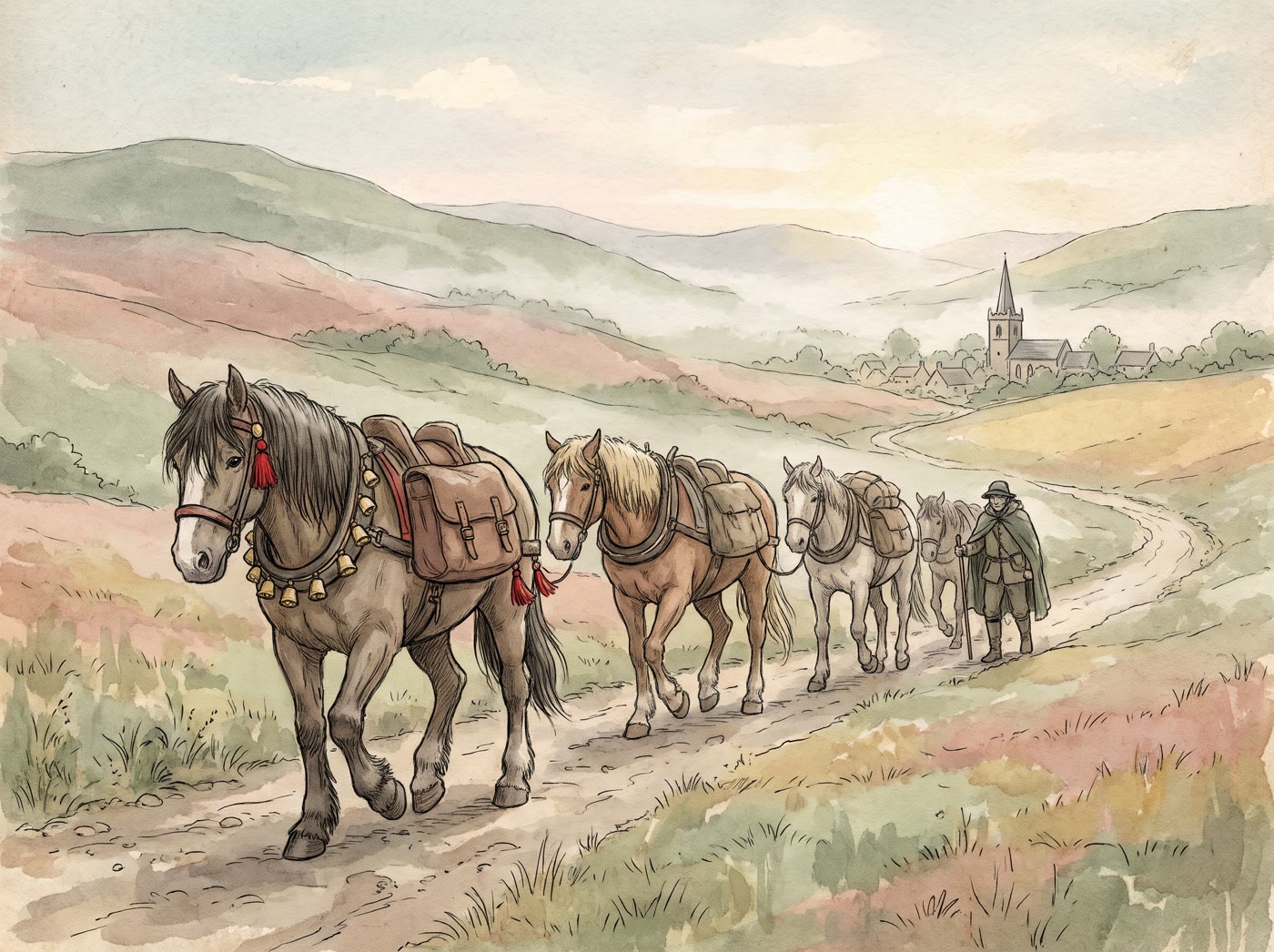
Bell horses, bell horses, what time of day?
One o’clock, two o’clock, three, and away!
Bell horses, bell horses, what time of day?
Two o’clock, three o’clock, four, and away!
Five o’clock, six o’clock, now time to stay!
Where the rhyme comes from
The rhyme was already in print by 1783, according to Alice Gomme’s Traditional Games of England, Scotland, and Ireland, which says it occurs in Gammer Gurton’s Garland of that year with the last words of the second line given as “time to away”. We have relied on Gomme for this and have not seen the 1783 text ourselves, so treat it as “by 1783 at the latest”: how much older the rhyme may be is not known.
Gomme prints two versions. The words above are the Shropshire one, which she takes from Charlotte Burne’s Shropshire Folk-lore; it is a game as well as a rhyme, played by children in a long line, one behind the other. They march and sing the first four lines, stand still for the fifth, and begin again. The second version comes from James Orchard Halliwell’s collection and starts “Bellasay, bellasay, what time of day?” before the same count of “One o’clock, two o’clock, three, and away”. The second line has other wordings too, and a shorter form — “what’s the time of day? One o’clock, two o’clock, time to away” — is the one given in modern music-teaching resources.
What does it mean?
The counting is plain enough: the answer to “what time of day?” runs through the hours and ends with a cry of “away!”, which is exactly what a starting signal needs. Gomme herself recalled the first two lines being used to start children in a race, and she notes similar race-starting verses from elsewhere, including one in Chambers’s Popular Rhymes that begins “Race horses, race horses, what time of day?”
The bell-horse as packhorse. Burne suggested a connection with the old packhorses, and a Mr Addy, writing in a Sheffield glossary, said that the first horse in a team carrying lead to be smelted wore bells and was called the bell-horse. That is a suggestion by two folklorists, not something the rhyme itself proves, but it fits the picture of a line of horses walking one behind the other — and of children doing the same.
The Bellasis theory. Halliwell, working from the odd word “Bellasay”, linked the game with a proverbial saying about the Bellasis family. Gomme dismissed the idea: she found no evidence for any such connection beyond the similarity of the word. It is best treated as an unevidenced guess.
Sharing it with children
The rhyme is made for starting things. Line up a few children at one end of the garden, chant the question together, and let the count of hours build the suspense until “away!” sends them off. It works as a race start, a hop-to-the-fence game or a slow-motion creep for children who need to calm down: the call is the same, only the way of travelling changes.
For a circle game, choose one child to be the bell horse and walk or gallop round the outside while everyone sings. At “away” the bell horse stops behind someone, who becomes the next horse. A hobby horse or a string of jingle bells adds to the fun. For slightly older children, use the rhyme to practise telling the time: hold up a toy clock face and let them say which o’clock comes next. It is a gentle companion to Hickory Dickory Dock, which also strikes the hours.
Extra verses to sing
These verses aren’t traditional — they’re ours. Use them to change the way everyone travels.
Bell horses, bell horses, how shall we go?
Tiptoe, tiptoe, ever so slow.
Bell horses, bell horses, jingle and ring,
Stop at the gate and wait for the king.
Bell horses, bell horses, hear the bells chime,
Trot to the meadow in jolly good time.
Bell horses, bell horses, when we get there,
Hay for the horses and one for the mare.