Rub-a-dub-dub
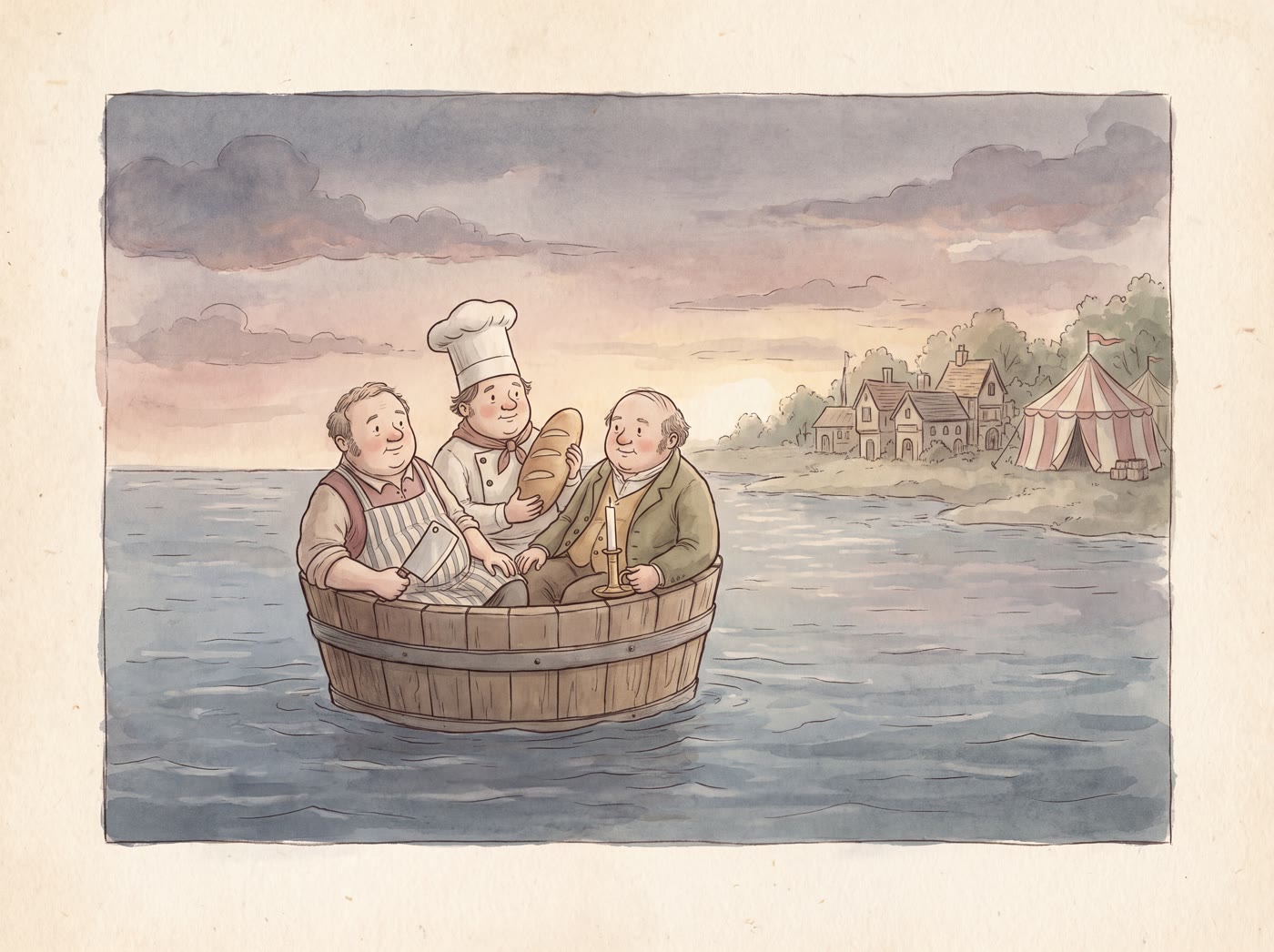
Rub-a-dub-dub,
Three men in a tub,
And who do you think they be?
The butcher, the baker,
The candlestick-maker,
And all of them out to sea.
Where the rhyme comes from
The words above are the familiar modern form, and they are not the earliest. The rhyme is also known as “Three Men in a Tub” and as “Rub a Dub Dub”, and it is catalogued as Roud 3101 in the Roud Folk Song Index. It was first printed at the end of the eighteenth century, in volume two of James Hook’s A Christmas Box (1798), under the title “Dub a dub dub”. We have not been able to read that volume, so we cannot tell you what its words were.
The first printed wording we can quote comes from Boston: Mother Goose’s Quarto, of about 1825, as given in the Opies’ Oxford Dictionary of Nursery Rhymes. It begins “Hey! rub-a-dub, ho! rub-a-dub, three maids in a tub” and ends with the butcher, the baker and the candlestick-maker “all of them gone to the fair”. The maids are reported to have disappeared from nursery-book versions by about 1830. In 1842 Halliwell printed a quite different ending: “Rub a dub dub, / Three fools in a tub … Turn them out, knaves all three.” The “out to sea” ending, with the three men sailing off, is the familiar modern one, and it has its own small variations: “all put out to sea” is one.
A word about the refrain. Rub-a-dub is an imitation of the sound of a drum, a sense that dictionaries record. Whether the rhyme borrowed the drum word, or the other way about, has not been established, so we would not build anything on it.
What does it mean?
The fair. The Opies, as they are reported, read the rhyme as three respectable townsfolk watching a dubious sideshow at a fair. It is an interpretation, not something any early source says outright.
A medieval origin. One popular writer has claimed that a version of the rhyme goes back to the fourteenth century. No early text has been produced to support it, and the earliest printing we can verify is four centuries or more later. We would treat it as a claim and nothing more.
A darker story? Parents do ask. The honest answer is that we found no evidence for anything sinister. The only edgy reading in the sources we checked is the fairground one above, and even that rests on thin evidence. As for the butcher, the baker and the candlestick-maker, there is no known hidden meaning: they are simply the sort of tradesmen you would expect to find in a town. The meaning of the rhyme, beyond a pleasing bit of nonsense with a rolling beat, is unknown.
Sharing it with children
At bath time the rhyme practically sings itself. Tap out “rub-a-dub-dub” on the side of the tub, or rub a flannel in slow circles on a knee or a tummy in time with the beat, then splash a little on “out to sea”. Hold up three fingers for the three men.
For play, put three toy figures in a washing-up bowl or a plastic tub of water and let the child act the verse: who is the butcher, who the baker, who the candlestick-maker? Float the tub across the water on the last line. Or leave the trades out and play a guessing game: say “rub-a-dub-dub, three men in a tub, and who do you think they be?” and let the child propose the passengers before you give the traditional three. For another round of guessing, The Muffin Man is another tradesman’s song, played as a question-and-answer game.
Extra verses to sing
These verses aren’t traditional — they’re ours. They give the tub a different crew, and a child can add a crew of their own.
Rub-a-dub-dub,
Three friends in a tub,
And who do you think they be?
The tailor, the miller,
The lavender-seller,
All sailing along with me.
Rub-a-dub-dub,
Three folk in a tub,
And who do you think they be?
The fiddler, the potter,
The gardener’s daughter,
All rowing for home and tea.