Matthew Mendlegs Missed a Mangled Monkey
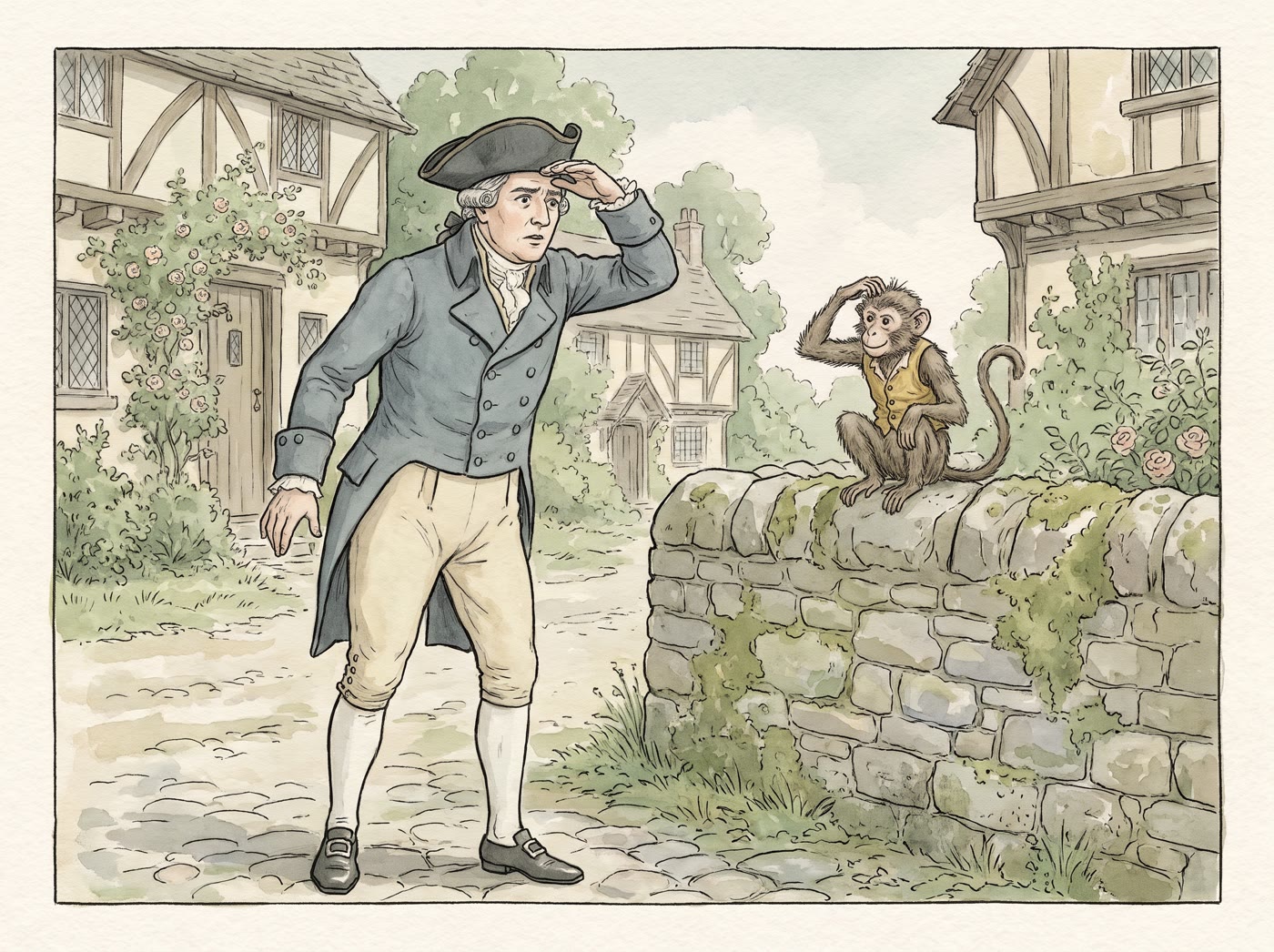
Matthew Mendlegs miss’d a mangled Monkey
Did Matthew Mendlegs miss a mangled Monkey?
If Matthew Mendlegs miss’d a mangled Monkey,
Where’s the mangled Monkey Matthew Mendlegs miss’d?
Where the rhyme comes from
Matthew Mendlegs is the M of an alphabet of tongue twisters, Peter Piper’s Practical Principles of Plain and Perfect Pronunciation, usually dated to an edition published in London by John Harris in 1813. The book gives one alliterative verse to each letter, and the best known by far is Peter Piper and his pickled peppers. Matthew sits between Lanky Lawrence (L) and Neddy Noodle (N).
The words above are those printed in an American edition of 1836, published in Philadelphia by Willard Johnson, which we have read in a transcription. We have not seen the 1813 text, so we cannot say whether its wording was the same. Note the old spelling “miss’d”, simply “missed” with an apostrophe, and the capitals on the nouns. This printing has no punctuation at the end of the first line, unlike most of its sister verses in the book, which end it with a colon.
Every verse in the book is built the same way: a statement, a doubting question, an “if” restatement and a closing question beginning “where”. It is a pronunciation drill dressed up as a joke. Other verses from the same book on this site include Sammy Smellie and Enoch Elkrig.
What does it mean?
Who was Matthew Mendlegs? Nobody knows. The book is anonymous, “Peter Piper” is a pseudonym, and we have found nothing that identifies a real Matthew Mendlegs. The name is most likely an invention, chosen because it begins with M like the other key words in the verse.
What is a mangled monkey? In everyday terms, “mangled” means knocked about and spoiled — battered out of shape. The verse says nothing about how the monkey came to be in that state, or why Matthew missed it, and we are not going to invent a story. Our own reading of the last line is that the monkey has simply gone astray and Matthew is left asking where it is. In practice the creature is best pictured as a rather scruffy monkey. The point of the verse is the sound: every line carries five or more M words, and the question-and-answer pattern gives you four chances to stumble over them.
Sharing it with children
Begin with the sound itself. M is made with the lips closed, so start with a long hummed “mmm” and feel the buzz on the lips. The trouble in this verse comes from M sitting beside N and the muddle of miss, mangled and Mendlegs: the lips must open and close again before the tongue has finished its work.
Build the verse one line at a time, at half speed, with a clap on each beat. Try “Matthew Mendlegs” five times in a row before attempting the whole line. Ask a child to find the M words in line one — Matthew, Mendlegs, miss’d, mangled, Monkey — and tick them off on their fingers. Then play it as a game: pass the verse round a circle a line each, faster with every lap, with a toy monkey handed on to whoever is speaking, and anyone who trips passes the monkey on. Whispering the verse is surprisingly harder than saying it aloud.
Extra verses to sing
These verses aren’t traditional — they’re ours. They follow the same four-line pattern as the original, so try them once the first verse comes easily.
Molly Muddle mended a mouldy Mitten,
Did Molly Muddle mend a mouldy Mitten?
If Molly Muddle mended a mouldy Mitten,
Where’s the mouldy Mitten Molly Muddle mended?
Marmaduke Mumble munched a marmalade Muffin,
Did Marmaduke Mumble munch a marmalade Muffin?
If Marmaduke Mumble munched a marmalade Muffin,
Where’s the marmalade Muffin Marmaduke Mumble munched?