Mrs Puggy Wuggy
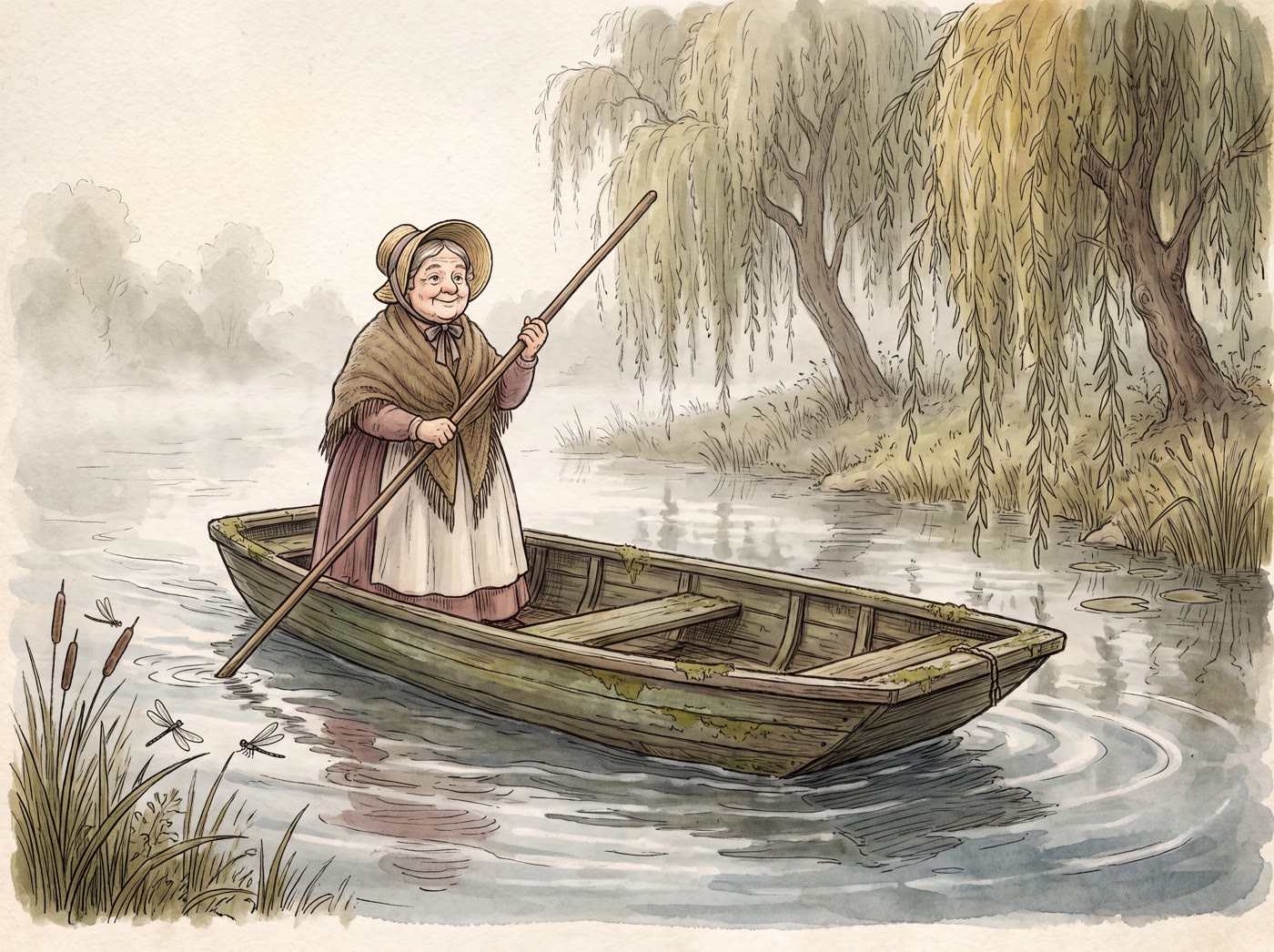
Mrs Puggy Wuggy has a square cut punt,
Not a punt cut square,
Just a square cut punt.
It’s round in the stern and blunt in the front,
Mrs Puggy Wuggy has a square cut punt.
Where the rhyme comes from
Mrs Puggy Wuggy belongs to the oral tradition rather than the printed one. Unlike Peter Piper, which can be traced to a printed alphabet book of 1813, no early published source for this twister has been identified. It circulates by word of mouth — in playgrounds, in scout huts, and above all in drama studios and radio booths, where actors and broadcasters have long used it as a vocal warm-up.
The vocabulary points to England, and to the flat rivers of the south: a punt is a flat-bottomed boat pushed along with a long pole, the sort still hired out on the Cam and the Isis. A “square cut” punt is simply one built with a squared-off end. The name “Puggy Wuggy” is nonsense of the affectionate nursery kind — “pug” was once a homely pet-name for a small, snub-nosed creature or person, and the doubled rhyming syllable is the same trick that gives us Georgie Porgie and Handy Pandy.
Close cousins of the verse turn up in oral collections, most commonly one that begins “Old Mother Hunt had a rough cut punt”. That family resemblance is a good sign of a genuinely traditional rhyme: versions drift, names change, but the trap at the heart of the lines stays exactly the same.
What does it mean?
On the surface, nothing at all: it is a boast about a boat. The whole point of the verse is mechanical, not narrative. It is a spoonerism trap, built so that the tired or hurried tongue will swap the opening sounds of two words and produce something quite different from what was intended.
The engine is the pairing of punt and cut, repeated in four different orders — “square cut punt”, “punt cut square”, “square cut punt” again — with blunt and front pushed in behind them. Your mouth has to reset the same two consonant clusters over and over at speed, and the brain begins to anticipate the wrong one. Linguists call this kind of slip an anticipatory exchange error; everyone else calls it getting the giggles.
Older printed and online copies of the rhyme often carry a warning that it should not be recited in front of children, and that warning is the whole joke: the near-miss is a rude word. Nothing in the text itself is coarse — the mischief lives entirely in the mistake. Any claim that the verse was written as a coded insult, or that Mrs Puggy Wuggy was a real person, is folklore rather than history; no evidence supports it.
Sharing it with children
Worth knowing before you start: because of the spoonerism trap described above, this is a twister for confident older children, teenagers and grown-ups rather than for little ones. With a younger group, Betty Botter or She Sells Sea Shells gives the same fun with none of the risk.
With an older group, treat it as a speed challenge. Start absurdly slowly, mouthing each word with exaggerated care, and only then creep the tempo up — accuracy first, pace second. Have everyone tap a steady beat on the table so the rhythm carries the words rather than the tongue having to fight for them. Then time one clean run each: three repetitions without a stumble is a very respectable score, and five is showing off. The stumbles are the entertainment, so award points for the funniest wreck as well as the fastest round.
For a calmer version, ask everyone to say it in a whisper. Whispering removes the voicing that makes the slip sound so alarming, and it forces beautifully crisp consonants — which is precisely why voice coaches like this one.
Extra verses to sing
These verses aren’t traditional — they’re ours. Add them once the first one stops tripping you up.
Mrs Puggy Wuggy has a long green pole,
Not a pole gone long,
Just a long green pole.
She pushes through the shallows and she skirts the hole,
Mrs Puggy Wuggy has a long green pole.
Mrs Puggy Wuggy has a fat brown punt-dog,
Not a dog gone brown,
Just a fat brown punt-dog.
He barks at every duck and he snores on every log,
Mrs Puggy Wuggy has a fat brown punt-dog.